Saturday, November 24, 2012
Litter Along the Great Information Highway


Thursday, March 08, 2012
Those Trees I Planted
AML wrote...
Every tree has a life to give and has a reason to leave. So planting more trees will help make the world green and wonderfull.
Few would want to argue with AML, and as I worked on the story that was eventually used in part by the author of “Onalaska,” I thought many times about the mighty and beautiful trees that were killed off so that his country might have houses and baseball bats and pianos, and whatever else entrepreneurs might use to create jobs and produce things that people wanted and needed.
And I also thought about the title of this blog, “Planting Trees.” I called it that not because I was thinking of elms and maples and cherry blossoms, but because I was thinking of putting ideas into the heads of young people. My trees were a metaphor for giant redwoods and palms and walnut trees--big ideas in the minds of our next generation.
After I retired from industry, I really went to work. I went to the local school district and said, “I want to be a substitute teacher.” I had two college degrees but they still made me take a test for aspiring teachers. It was absurdly easy, and after the local police checked me out, I found myself in a classroom.
Standing in front of 35 kids every day from seventh grade to high school age kids, I found that I had a very high office. Yes, I had taught three semesters of a management course in college, but I did not like doing it. About half of my students were graduate students and half were undergraduate students. The experience was kind of frustrating for me.
But when I found myself in front of an algebra class, or a science class in public school, I was really at home for two reasons. One reason had to do with Democracy. Public schools are where Democracy is ingrained into the minds of our young people. I supported it every way I could. Sometimes this meant protecting possible gay children and always it meant protecting small girls from being trampled by big boys. It often meant discouraging rumors and false stories about one race being superior to another. It meant telling girls that they could do math just as well as boys (which is absolutely true).
It never occurred to me to present just one side of a story, no matter what I personally felt. I might miss some “trees” that way.
The second reason I felt at home is that I was able to plant other trees. When there were breaks in a lesson, I told funny stories about my own family life when I was a kid with two older, meaner brothers. My own children were grown, so I talked about them and their injuries. These tales reinforced the idea of a strong family which protected its members and shared its sorrows as well as its joys. These were “trees” also.
Planting trees in public schools this way allowed me to explain science and math in new ways as well as telling true stories about our country’s history that reinforced the American culture.
The kids asked for copies of my stories so I wrote first one book and then nine more. Parents asked for me when they found that a teacher was going to be absent, and asked for me to tutor their kids. I didn’t need the money and my health was failing, so I had to slow down over time and then finally quit altogether.
During this time and even after I came to believe that it would serve the students and teachers well if more older people volunteered to be substitute teachers. Older citizens had something important to say about what they had observed over the years.
As for me, I knew that teaching was one of the most important jobs I ever had. I was allowed to plant many trees for about five or six years. Fortunately, I was teaching in one of the best schools in one of the best school districts of the state of California. It was an honor to be included as a teacher with the REAL teachers in that district who were full time professionals.
I retired from a job in industry where I managed the people who managed divisions of manufacturing companies. I was, by all accounts a professional manager. And yet, nothing was as fulfilling as those years I was allowed to stand in front of a classroom of kids from all over the world and plant American trees along with Algebra, Science, and Social Studies.
So yes, AML, planting more trees will help make the world green and wonderful.
Wednesday, August 24, 2011
The Book I Did Not Write

It must have been four years ago when I got an email from a guy named Vic. He was researching a story about the lumber industry in the Midwest to the Far West. In doing so he came across one of my family lines and then my name as a submitter of the information.
Vic introduced himself and then began asking questions. It was then that I had to ask myself a question: was I going to write a book about these cousins or not? If not, would I object to letting someone else write their story?
So I didn’t respond to Vic right away. I thought it over for several weeks (while I worked on another book) and then decided to let Vic use my information.
At first, I sent Vic what only he asked for. Then I asked if he knew some strange stories of the deaths of several of my people. He didn’t, so I sent the details and photographs. This led to other questions and materials flying back and forth across the Internet and soon I was learning things about my family. Then I began to look forward to Vic’s emails. I dug deeper into my own piles of papers for him. And then came the announcement: the book was finished. I would be getting a copy in a week or so.
For me, it all began with the murder of my great-grandfather in 1874. I wrote about him and the cowardly backshooting by the KKK in those ugly days after the Civil War. I followed the family afterwards because witnesses against the Klan did not live long and I wanted to see what had happened to them. Three brothers disappeared completely. One had been killed and the other two may have fled to what is now Panama.
A fourth brother, Tom Walker, testified and then fled out west. He had been a shopkeeper at home but out west he started stores and banks to serve settlers in Kansas and Missouri. He died in 1931 as a very wealthy man. His family line ran out in 1967 when his only grandson, a gay man, died young of cancer. It was Tom’s family’s epic tale that I wanted to write about.
It seems Tom Walker had a daughter who married a wealthy young man named Bill Carlisle. The Carlisle family was very big nationally in the lumber industry. The new family soon produced two sons. Tommy was killed by a drunk driver in 1937. The driver died in a mysterious fire soon after. Money from both sides of the family ended up in the hands of Tom Walker’s other grandson, Bill Carlisle.
Bill was very interested in the Metropolitan Opera in New York City, and not the lumber industry. He and his partner would go to New York and would throw parties for the artsy folks. I have a letter at the time of his death that said, “Bill has died. I notified the Roosevelts, Andre Kostelanitz, Rosa Ponselle . . . (and other luminaries of the social set in the 1960’s).” Bill’s partner lives within thirty miles of me at Laguna Beach as I write this, but is very reclusive and will not talk to me.
So Vic wrote a very interesting book about the lumber industry and the people who founded it using most of his own enormous research, but he flavored his interesting work with materials I had sent him. After reading the book, I found I was glad that I had done my family history, glad that it had been useful to someone else, and glad that I had placed their names on the Internet.
Vic is a good, interesting writer. He has the knack of making a well-documented history seem like a novel. Ken Burns, Dayton Duncan and others whose historical works appeared on PBS have that same ability. They are inventing a new genre which fits genealogists needs very nicely.
The name of the book is Onalaska and the author’s full name is Victor J. Kucera. I recommend it as an interesting book by itself, but also as an example of how you can organize and present that genealogy you have in the back of your head. The book has 340 pages plus an appendix, end notes, time line and an index. It will be available in early 2012.
Onalaska is a book I did not write. But I wish I had. I would say more about it but I just discovered a letter my grandmother wrote to Tommy’s mother after the car crash in 1937. Maybe I can get it to Vic so he can include it in the final edition.
One more thing: you just don’t know when the material you collected is going to be useful to you or to someone else. That is why it is worth the effort to be the “expert” on your family and to have the information handy. And it is useful to let someone on the Internet know that you have it.
Saturday, April 02, 2011
Unconventional Wisdom
One of the dot com book companies sent me a small book of poems by my favorite author, Wendell Berry.* In one short poem Wendell described a Thomas Fiske method of doing genealogy that I thought was particularly useful. He wrote about his gratitude for his children and grandchildren and then said:
At our dinners together, the dead
Enter and pass among us
In living love and in memory.
And so the young are taught.
I showed the poem to my wife Evie, and tears came to her eyes as she thought of her pretty daughter Julie, who was killed by a drunk driver on the eve of her wedding some twenty years ago. We have often talked about Julie with the grandchildren at the dinner table.
In the author’s artful description, not only is ancestry passed on but also it is used to teach the young. I cannot write how many times my family meals were conducted this way, in which “the dead enter(ed) and pass(ed) among us” as someone told a story about a person from the past.
It is a good thing the dead don’t eat much, because many of these meals were conducted during the Great Depression or during WWII when food was scarce. But no matter how hungry I was, I always remembered the stories my parents or grandparents told. Now that my children are getting older they remind me that I told them stories as well.
I am forced to wonder how much damage I did by telling the “racier” stories about my two older brothers and me rather than the stories in which we helped someone or showed some kindness.
But that is water under the bridge. Having a long memory, I became the family genealogist and put my parents’ stories to good use. I hope my grandchildren will save those tales for their kids. All things considered, I managed to make the stories into learning experiences in which I passed on part of the American culture. Maybe the dead paused long enough to approve.
Of course they heard stories “in living love” because they were family and when I tell stories, family members always wear white hats - maybe hats with footprints on them or with holes through the crowns because we had our share of screwballs. But always they had white hats because they were the good guys.
I kind of forgot the other kind of stories.
*Berry, Wendell, Leavings. Berkeley, CA: Counterpoint, 2011, p.41
Wednesday, February 02, 2011
JFK's Joke on the American People
Premier Khrushchev of the USSR had to be in agreement, of course. He was ousted in 1964, so Premier Brezhnev had a choice to make. He chose to keep the program intact. The scientist secretly flew back and forth to the USSR for about nine years, while the US was competing with the USSR to be first to send a man to the moon.
I knew the space medicine scientist, who died a few years ago. After I wrote the book, I sent a letter to one of his children, also a scientist, saying that the book was on the market but that I had altered the scientist’s name and home city.
A few weeks ago I got a letter from a child of the scientist. It was very informative. He did not know I had written the book and he did not know what his father had been up to. Here is what he said, in part:
Dear Mr. Fiske,
On the advice of my sibling, I have read your book The Insider. Needless to say, the content left me floored. I had no idea that my father led a double life as our country strove to put a man on the moon. My next reaction is to thank you for helping to fill in some of the blanks of my father’s life. He was remarkably careful in what he would tell us about his work and it was clear that he had a lot more to say. Without your patient and persistent interviews the story would have died with him. I am very grateful that you were willing to take the time and personal risk and write your book. A couple years prior to his death I had arranged for a physiologist working on the history of space flight to interview Dad. His health was already failing and his Parkinson’s (disease) made communication difficult. Dad refused to meet with the physiologist and I always regretted the opportunity missed. I should have known that Dad would have arranged for an interview on his terms.
The interview was with me. I am not a physiologist, however. Nor did I intend to write about the scientist. While I got a crash course in physiology from the scientist, little of it “took.” I am an MBA and more of a student of management and an economist that a medicine man. I never liked biology and its off-shoots. Once the scientist had told someone about his adventure, he said nothing to anyone else. I was working under the theory that his children knew what their father had accomplished, but the letter tells me I was wrong.
It appears that his wife knew and I knew. She was also my friend. But in this country, we three knew alone knew of the very brave things the scientist accomplished. Of course, two Intel agencies knew, but it all took place over forty years ago, and most of them are dead or retired by now. Newer staff doesn’t care and is busy working on other problems. Still, no one in our Government is giving up any information, willingly. The Russians know and have long memories. They would rather not let the world know that they had important assistance from the US when they were setting all kinds of records in space. It is not a time of ease at my house.
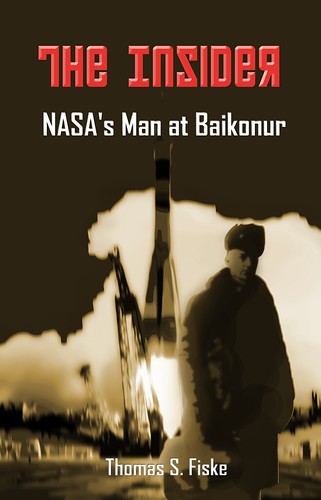
I called the book The Insider: NASA’s Man at Baikonur. It is available at the usual dot com book stores.
Sunday, September 19, 2010
Scheherazade and New Podcasts
The podcast is a series of stories I tell from my book “Four on the Floor.” After I left industry, I spent a few years teaching math and science in public schools as a sub. It was fun for me and the kids were generally great to work with. There were times when the lesson was over and the bell had not rung. I used those times to tell stories about my kids or my brothers, or exotic stories from science or history.
And kid love gore. For instance, they loved to hear about the time my older brother blew his big toe off with a shotgun. That was a gun safety story. There was a reason for each of these tales. Kids always want to know why you tell a story.
Of course, the kids asked me to write my stories (I suppose that was so they could tell them to their kids). Eventually I did just that and now, nine books later, I’ve about decided to quit writing. If you want to hear one of my stories you can go to the right side of this page to Links and click the words “Four on the Floor Podcasts.” Read by the author.
Scheherazade was the best story teller there ever was, with her Arabian Nights stories, much better than I. But she was highly motivated. My only motivation was to pass along the art of story telling to a bunch of kids, just to let them know there was something more interesting in life than TV. I may have convinced a few.
Monday, August 30, 2010
Unintended Consequences
The Smoot-Hawley Tariff Act of 1930 was designed to increase revenues for America and protect American jobs, but it almost single-handedly destroyed the world’s economy. And was it President Clinton’s administration that caused taxes to be raised on luxury boats? The result was that the poor guys who made boats were suddenly out of work.
Individuals can cause unintended consequences as well. When I began to write my book, The Insider I had no ill will against anyone. Yet, as the book is about to appear on the market, I found I have caused damage to a great American astronaut. I had no such intention.
It was in 2002 that General and astronaut Thomas Stafford produced his book, We Have Capture. It is a good book and I recommend it. The General is an American hero. Unfortunately, Stafford thought he was the first American to reach the secret Soviet launch station called Baikonur in April of 1975. He said so in his book.
General Stafford was not at all the first American to reach that space launch station. If it were not central to my book, I would have said nothing, but my book is about the guy who did get there first, and why he went there.
The Insider is about Tad Benson, MD, a space medicine scientist. President Kennedy got him to agree (through Hugh Dryden) to go to both Moscow and Baikonur to share ideas on space medicine. Oh, I know there are lots of people who said Khrushchev and Kennedy never reached an agreement on this subject, but they are wrong. Benson spent almost nine years traveling back and forth to the USSR, doing what he could to keep both cosmonauts and astronauts alive in space.
I knew Benson. He was a serious man a good friend who died too early. I checked with various agencies of the federal government to find out what he was doing during the years 1962-1971, and found that Benson had been a contractor to the NSA, CIA, NASA and other groups. I found that he also got an award from the USSR for his work.
There was a stranger on Gen Stafford’s plane to Siberia. He was on the bus when it arrived at the launch station. Stafford did not mention that Soviet scientists hugged and otherwise ganged up around the stranger, slapping him on the back and ignoring the other Americans. Tad told me about it, and the story appeared elsewhere in the Internet. Tad said that the other scientists wondered, “How did the Soviets know this guy?” but they were never told.
So I told the story in my book The Insider, with as much detail as I could. Tad was dying as he told me and we did not have a whole lot of time. I did not set out to take any of the glory that General Stafford richly deserves. But I did want to tell Tad’s story because I am one of the few in the world who knows it. And my health isn’t all that great.
The really sad part of the story about Tad and his heroic adventures is that I am not allowed to use his real name.
Wednesday, June 16, 2010
Turning in My Quill Pen and Ink
Most of the books I wrote were non-fiction. They contained stories that I knew had to be told. Just had to be told before I kicked the bucket. No one else could have told those stories. I may have made some of those stories into fiction for various reasons (there are always reasons for not publishing a story including “it might offend someone”).
Making them into fiction is just a slight extra demand on the author. Some of us are mere reporters and do not know how to do anything but list events and the people who caused them. There is very little challenge in just reporting.
Anyway, at almost the end of my trail, I think I’ll quit writing books. Even though there’s some modest glory in being America’s least-read writer, I don’t care. I only know that on my bookshelf is a collection of nine, soon to be ten, books. And lots of articles as well. I wrote them.
As I said, the stories had to be told. Not telling them created pressure. Now the pressure is off.
The books are like paintings. You can look at them and like them or not like them. It doesn’t matter. They are there, ten books that weren’t anywhere fifteen years ago. They contain ideas and remembrances and historical details for any and all to see. What’s more, the books are edifying and nearly every word is spelled correctly.
There was a time when I was just starting out in the literary world at age seven. In those days my goal was to read a complete book. It was hard to read them all the way through and I knew I would be proud of myself if I could concentrate long enough just to read every page. Eventually I reached that goal and that began my life-long love of books.
How many times did I wander into my college’s book store and smell the wonderful aroma of paper and paste and whatever it is that makes a new book smell so good? My romance over the years never flagged.
Sometime during my college experience, though, I began to look at books differently. There was a time when, if I didn’t understand a book, I would put it down and think I was too dumb. After my MBA degree, the truth hit me: if I could not understand a book, I would lay it aside and say to myself, “That author can’t write.” But I still loved books. They had to be well written, however.
During my first fifty years never did I dream I would be able to write a book. I did not even want to write one because I realized I was not of the writer class, I was of the reader class. Most of us are that way. But then I turned over several rocks in my family history foundation and there they were—the stories that had to be told.
Now I have done my duty. I have told the stories of murder and war and struggle during WWII followed by the Space Race and the Cold War. It is someone else’s turn. I will not listen to any more stories, much less tell them. Now I am content to read very well written books, preferably new ones that have crisp clean pages.
Don’t offer me something on the Internet. I hate computer screens. I just want to turn pages and look at black words on white pages, words that can bring back memories or cause me to dream great dreams. I think I have earned that privilege.
It may take a lot of perseverance not to write another book, but I believe I will win out.
I think the literary world will survive. After all, I still have my blog to work on, and the Genealogy blog as well, and maybe an engineering magazine or two.
Wednesday, May 26, 2010
On Producing a Book
Anybody can write a book. Producing a book is very hard. It is right up there with producing a new product for a large company such as General Electric. I have done both and I am not sure which is more difficult.
A new appliance starts with the drawings and specifications. From these you have tools made and you buy equipment that holds the tools. You design the tests and find space for the rest of the production facilities including assembly lines. You make sure pilot models work as they are made on equipment you will use in actual production. And you assure that the boxes they are sold in are made correctly, fit the product and look good.
Authors would be well-served if they had a mental image of the finished product sitting on their shelves. They need a rough idea of the plot, but must be flexible. Characters do not always do what you want them to do. So plot changes will probably occur. A new book requires front and back covers, well-edited text, pictures of acceptable quality, readable type size with the correct font. Covers do sell books, you know. Chapters must be appropriately ended. A book is in fact a list of details that must be accomplished before it can be completed. Tables of contents and indexes must be prepared. There seem to be no end of concerns for you to handle personally before the book is ready for production.
Finally, each author of a new book is an entrepreneur, trying to sell copies in the face of stiff competition from many other authors with the same idea. But if he has a good story, he will never be at rest until he has written it and has seen the book on people’s shelves.
In spite of all this, I have completed my last book. I named it The Insider. It is a novel about an American doctor who spent nine years flying into and out of the USSR during the Space Race when the US and USSR were competing with each other to be the first to land a man on the moon. President John F. Kennedy got Premier Khrushchev of the USSR to allow a NASA doctor to visit the USSR’s secret space launch site about 1963 in spite of problems in Cuba and other US-USSR conflicts. These two world leaders were looking far ahead in the space business.
All the experts say it did not happen. But it did and the man they sent was a friend. The few Government records that still exist support the NASA scientist’s story, even though most were hidden from me and any other writer. It seems that most writer-experts relied on the CIA to tell them the truth, or they relied on people in the USSR to tell them the full story. You may have noticed that books by and about Khrushchev just did not talk about the space program. It seems that the US Congress did not know about the doctor, either. If they did, they would have blabbed about him to everyone they knew. But they thought there was a serious competition and had no idea we were helping the Soviets.
But that was over forty years ago, almost fifty years now. Do you think anybody is willing to release the files on this simple doctor who helped keep Soviet cosmonauts alive? Not in this country. Perhaps one Soviet cosmonaut is still alive who might be interested in telling what he knows.
Anyway, the pain of producing The Insider is almost over. The anticipation of the joy of upsetting self-proclaimed “experts” has kept me to the task. I don’t have any more book ideas now, and this will be my tenth book, so I think I will quit.
Sunday, May 09, 2010
Make Way for a Mensch
Often I write about how we are pieces of a movement that enriches the world. It’s the ‘Merican way. If you do your genealogy, you know that. Many Americans have enriched the world through medical research, industrial research and computer research among other ways. What do I mean?
Well, ours is the country large enough and free enough to conduct a medical business that has money left over, a surplus, with which to invent new medicines and machines that will help people get well. Other countries have medical systems that are dominated by government. Their government has taken away all incentives to produce new medicines and machines. They rely on the
My own background is in industry. I cannot tell you because I do not remember how many of my inventions and methods were used to manufacture devices in a less costly manner so that poor people could afford them. Most of these devices were useful in removing dirt and germs, so people lived better. And they had jobs they could depend on.
Of course, the computer industry revitalized our economy in the 1980’s. Not only did we get a useful product, the computer, but also we got a lot of jobs for people. Wealth was created. We were free enough to evolve an entirely new industry the rest of the world did not have. So we all have benefited .
Who was the guy that invented the computer hard drive? I don’t know. But I know he was a piece of the pattern that produced fast, long-lasting computer machines. And that is about all we can hope for—to be a piece of the pattern. Just as our forefathers and mothers were part of the pattern, adding a nip here and a tuck there in the human quilt, voting for the kind of place they wanted their children to grow up in.
Yesterday, I got word that my brother-in-law died. He had been a professor of some arcane subject in the mechanical engineering school of a large state university. Using his knowledge he developed tomorrow’s inventors. He also came up with some pretty good ideas, himself. But he had another attribute. He was a mensch.
Ordinarily, I do not like to use foreign words when I write. I love the English language (which is about 59% Latin). But we don’t have the word for everything. A mensch, if you don’t know, is Yiddish for
“Someone to admire and emulate, someone of noble character. The key to being “a real mensch” is nothing less than character, rectitude, dignity, a sense of what is right, responsible, decorous.”
(I found this definition on an interesting blog: http://blog.guykawasaki.com/2006/02/how_to_be_a_men.html#ixzz0nNsQo1TS)
It was wonderful to have such a man in the family: quiet, unassuming and brilliant. He wasn’t a mensch because he was a professor. He was a mensch because of his life pattern of conduct. The fact that he was interested in genealogy, the fact that he was a very good pianist and the fact that he was a fine Christian person had nothing to do with his mensch-ness. That was because he chose to live a certain way and he stuck with it.
His name was David Shippy, PhD. He was called professor but his real occupation was to contribute to society and his country in a positive way for as long as he could. In that occupation he was successful. His two children are contributors as well. An attitude like Dave’s is contagious. We’ll probably never know how large his contribution was, but you can bet it was big and red and fit extremely well in the fabric of our social well-being. And it will last for a long time. But you have to stand back to see it. The whole thing has been growing for over two hundred and thirty years.
Wednesday, April 14, 2010
Digging in the Past
http://www.genealogyblog.com/
Don’t Dig Up the Past!
Maybe it is just my family that has problems, but probably not. I just know that I have been warned not to dig up the past by very serious cousins. On more than one occasion and on more than one family line. Of course, reasons were not offered (that would ruin the fun of making the warning).
I have never agreed to stop turning over rocks and looking under them. I just couldn’t agree when I did not know what was hidden there waiting for me to find. In fact, I was spurred on by such warnings.
Of course I found ugly things, especially surrounding the reputations of those who were murdered. That is because it was necessary to blacken the names of those who were about to die. You see, if a murderer went to trial, it was helpful to have killed a bad guy. Juries understand bad guys. Lawyers love to try the victims instead of the perpetr ators. Researchers have to learn to overlook purposeful blackening of names, especially when the victim was involved in a worthy purpose such as interfering with the KKK.
Do you know how the KKK was tracked down in rural areas in 1874? The deputy US Marshall went to retail shops and found out who was selling white sheets. And then he found out who was buying those sheets. Killers who hide under white sheets in the cover of night probably are not good judges of character, and when they are the ones spreading the stories about someone else, you can take those stories with a grain of salt.
When I began researching, I didn’t know who in my family was a good guy and who was not. I just dug until I found the facts. If I found evil people, that is what I reported. If I found good people (or, “just not bad” people), I would report that as well. Mainly, I found what type of enemies an ancestor had. By learning about his enemies, I could get a grasp on my ancestor’s character.
But I will admit that I tend to think the best of someone until I learn differently. After all, saints and sinners abound in this world and have done so for thousands of years. There seem to have been more sinners than saints, making the search for holy folks take a little longer than the search for us ordinary types.
Now that I mention it, I do not recall anyone in my family who could qualify as a saint. There were a few ministers and one who was both a doctor and a minister. He was in St. Charles, MO in 1809-1811 when the biggest quakes in the US hit the Midwest and I don’t know if he uttered one cuss word. That might qualify him for sainthood. I didn’t look at him as a saint, however, but as an entrepreneur. Because he was both a doctor and a preacher, he made money when people were coming and going. Smart man, but not necessarily a saint.
And there was my cousin Jefferson Davis Grover (b. 1861and named for a Southern Saint) who was described by female cousins as the “handsomest man in the world.” He died in 1925 in rather odd circumstances as told by his third wife. He would not be a candidate for sainthood, either, unless you listened to his girlfriends.
There was a cousin, once, whom family members talked about in quiet whispers. It seems her mother was not married to her father, but everyone knew about her birth. Of course, she was properly ostracized. I have tried to locate this cousin who in my mind had no control over what her parents did. I always felt she was treated rather shabbily. She seems to want nothing to with the rest of us for some reason. I can’t say I blame her. To the best of my knowledge she has not taken a shot at any of us. Maybe she is more of a saint than any of us realize.
Digging up the past is fun, as long as no one is hurt by it. To this day, I have no idea why my cousins advised that I not research the family. Maybe they heard something I missed. Most likely they believed something that on the truth scale, ran between zero and one-half. Maybe it made them feel important to be the sharer of family secrets.
Monday, April 05, 2010
No Messages by Me from Beyond the Grave
I am still writing posts for the blog of my friend Leland Meitzner, the genealogy guru at http://www.genealogyblog.com/. Here is one that is self-explanatory:
Beyond the Grave
Filed in Thomas Fiske articles on Apr.05, 2010
Another amusing article by my friend, Tom Fiske:
I saw an Internet article titled “Texting from Beyond the Grave.” New technology allows a person to embed a chip in his or her granite tombstone that can be excited by telephones in the future so that a dead person’s typed message can be read out. Maybe a photo, too…
And I thought, “Some people just can’t let go.” But I also wondered if I were to leave such a statement, what my last message to the world might be. Would it be something like, “I told Evie I was sick…” or “Love your neighbor,” something that has been done much better and more often in the Bible. I just do not know. I doubt it would be one of those silly items that people send each other on the Internet each day—you know, one of those stories that is simply too cute to pass up, so you have to send the drivel on. Finding the right message would be a tough decision.
One day in 1944 in middle school a teacher had a boy by the name of Gilbert Lutz stand beside him in class. He commended the boy on his ability to carve. It seems the kid had boldly carved his name in a wood toilet seat in the boys’ bathroom. The teacher finished his special address to the carver by saying, “Of course, if that is where you want your name for all the world to see, you certainly have made your mark on the world.” I heard later that his parents were forced to replace the seat. We students wondered if Gilbert was allowed to keep the old seat so he could frame it and hang it on his wall at home.
So these new granite/electronic tombstones carry with them a great responsibility. But we genealogists can forget about them (and unadorned toilet seats, too) because we are already leaving powerful messages behind. Just a short list of a few generations would do, but many of us are also writing about our lives and the lives of our parents and even their parents. Most of these are monumental tales of proud, inner-directed folks.
I recall a Jewish lady who went to Poland in search of her ancestors. She was directed to a German Concentration Camp where her ancestors were put to death. Hers was a poignant story of bravery and destruction that carried with it a reminder of what can happen when we do not watch our political leaders very, very carefully.
My family was not Jewish (that we know of) but it consisted of soldiers in various wars. One was a corporal under Daniel Boone and General George Rogers Clark around 1784. He was not a big-time hero, but his deeds and deeds of those with whom he served, helped form this country. Those were the days when both mom and dad had to be good shots with a long rifle. Some of my people were Indians as well, so I came from a vast collection of shooters and shootees. They had very instructive tales to tell and I am writing them down as well as I am able.
You may choose a different course, but I believe I will forgo the granite messaging service, but will let my genealogy be my testimony, and my message for future generations.
Maybe I can’t let go either.
Saturday, March 27, 2010
Hamburgers and Spies
Cold Case Ancestors and Spies
It’s not that I have given up on Genealogy. It’s just that all the easy stuff has come to light. Now I am down to searching through Bavarian files from the 1800’s and early American files from the 1800’s. Not as much fun as it used to be. And the “oh, ho” remarks are sounding more and more like “oy,vey.” After all, I have been at it since I broke 100% of my legs about 1990. That’s about 20 years.
Yes, I know many of you readers have been at it much longer than twenty years, and I have taken advantage of the Internet during my twenty years. But you know what I mean: the easy data come first and then you run out of easy data unless you hail from a series of large families (another of Fiske’s maxims is that large families produce more genealogists than small families, making research come much more easily).
As I sat back to write this year’s Christmas letter to friends (Evie insists on doing a letter for family members) I gave a thought to bragging points. It wasn’t long before I realized I was at an age when the length of a surgery scar was more important than the length of a holiday trip. But I could talk about my new book, Ploughshares into Swords, which was selling a few copies; I could mention my wild run-in with the CIA having to do with my tenth book; and there were two huge breakthroughs in my genealogy studies.
Nobody much cares about somebody else’s genealogy, though. Unless it involves historical figures. And part of mine was historical, in a way. I had put away my folder on one of the members of the Lewis and Clark Expedition. This “cold case” was Sgt. Nathaniel Hale Pryor, who supposedly had a son, also named Nathaniel, born in Louisville, KY about 1806. (My mother was a Pryor, who was born near Louisville in 1902, so I always had an interest in this family.) Senior was definitely historical and Junior Pryor was instrumental in making sure California went to the United States when Mexico lost its hold, so I think he was also an historical figure.
This is the year (2009) in which I found that Junior was a son of Senior and that both Junior and Senior have descendants who are alive and kicking as this is being written. Some of Junior’s descendants are actually grateful for my work in proving their relation to Senior, but it doesn’t do much good. Actual proof of Senior’s ancestry goes back a generation or two in early Virginia. Then it seems to fade away, although I think I know where it goes after that.
The important thing to me is that those Pryors were Americans-- not original settlers perhaps, but very early, anyway. Weren’t there already English people in Virginia when the Mayflower landed in Plymouth, MA, in 1620? I personally have seen Plymouth Rock and I am no more proud of it than I am those kinder shores in V irginia upstream from where George Washington’s family arrived years later.
Being American is what counts, regardless of the year of entry to our country.
I said there were two big breakthroughs this year. The Pryors were the first. What was the second? Well, my Bavarian great-grandfather Adam had two families. His wife died in the 1860’s in Louisville, leaving him with four small children. One of them died and he farmed out the rest. But I didn’t know that. All I knew was that the first set of kids disappeared from all records before 1870. I spent many years looking for those youngsters. Finding all of Adam’s second family had been a chore (and that’s my group), so I closed and put away the folder on his first family several years ago. They became another cold case.
Then, about September, a descendant of a kid in the first family sent me an email. Despite all I could do to discourage him, this young man proved he was indeed my cousin. We shared Adam as an ancestor, but not Adam’s wife. Cheerfully and gratefully, I shared what I knew about Adam. He came from Bavaria, he said, and that is I all I know about the guy. Oh, a good guess is that he lived in the Pfalz area , but that really is all I know.
So I have learned three things in 2009. Two are specific items about my family members and the third is that there are no such things as truly cold cases.
One more thing—when I meet certain people in a restaurant to get background material for my next book, I am taking a camera. I hate being spied on.
Wednesday, March 24, 2010
Practical Communism
I noticed that the new US health bill provides for 16,000 additional IRS agents. I wonder how well they shoot?
God help us!
Tuesday, March 02, 2010
The Fire Is Out
Once I wrote a book just for fun. It was about time travel and it was called, Time Out of Joint, a quote from one W. Shakespeare. Nothing was burning a hole in my gut until I finished that story—Maya’s agony was missing. But it came out all right.
The rest of my books, all eight or nine of them, though—they were born of agony. I knew I had to write them or be very uncomfortable the rest of my days. It was family stuff—stories about family members who died for a cause or did something unusual—those true tales pressured me into writing.
This final story is about a friend, a doctor who spent some nine years in the USSR during the space race. Through him (I call him Tad Benson), the US and the USSR shared space medicine information. President John F. Kennedy and Premier Nikita Khrushchev set up the program. But the USSR could not admit it had help from the US and the US could not admit it had helped the USSR for a variety of reasons. So, even today the story I told is universally denied.
Tad died a few years ago, an unsung hero. All his years of inventing, testing and establishing friendships in two major countries have gone down the drain. But he reached his goal and did not lose an astronaut or cosmonaut during his time of caring for them.
Tad’s story produced agony until it was written. It is called The Insider—NASA’s Man in Baikonur. Baikonur was the name of the secret Soviet rocket launch site.
Now I can rest.
When I give a talk about one of my books, there is always someone in the audience, or maybe two, who say, “I know a story about ____. But I never got around to writing it.”
My response has always been, “When it burns a hole in your gut, you’ll write that story.” That was a long time before I read Maya’s quote. But I knew, I just was certain that the burning of the gut is what drove me and very likely drives many other writers.
When people ask me, “What kinds of reviews did you get for this book?” I tell them the truth. And the truth is that I don’t care. Once the fire is out and the book is complete I can live again. I don’t read the few reviews that I get. It is too late to do anything about them because the book is finished and I am on to another project.
Well, I am through with projects. I refuse to hear about any more of them.
And finally, the fire is out.
Saturday, November 28, 2009
Writing for Friends
Here is the URL of the Genealogy Blog: http://www.genealogyblog.com/
Intel Agencies--Another First
At the outer fringes of my youth and well over sixty years of age, I am still a kid a heart. So I really was interested in my first Spook event. No, it’s too late for Halloween, I mean another kind of spook, entirely.
You see, I was at a hamburger place recently. I agreed to meet with a fellow radio Ham and a man who said he had once been with the CIA. I wanted background material for my next book, which is highly complimentary of the CIA and US Intel agencies. I had asked the CIA and others for help with the project, so I know they know what I am doing. I have no secrets. A little advertising is always a lot of help.
So I got to the restaurant and waited for the other two men to show up. The Ham came first. Having worked in the electronics industry, George is a few years older than I and has many more years of electronic experience. I don’t know what he worked on. He isn’t allowed to tell me and he doesn’t. Maybe he didn’t even work on electronics.
We started with a pair of lemonades while we waited for Jack, the third guy. George and I sat in a booth in the back of the restaurant where we hear but could not be overheard. He chose the booth. We talked for a few minutes and I made notes. It was subtle, but I noticed that George changed topics and began to tell me about things he had mentioned before. Soon he was telling innocuous stories about physics. It was hard for me to follow. Something was plainly wrong. I thought it was because Jack had not showed up and he was stalling for time.
Eventually Jack arrived and sat down. He was very vague as well. He went to get himself a lemonade. I noticed a man sitting in a booth facing ours. He was reading a girly novel and holding the book in a peculiar fashion. I thought little about him.
When Jack returned he suggested moving to another booth. There, he sat against the wall where he could see out across the room. He and George made remarks to each other that I did not understand. I told them, “You guys are like twins who have your own private language. I wish I knew what was going on.” At that moment, the reader stood and called for a waitress. He told her there was a package under the table where we had been sitting. She came over and got it to put in their “lost and found” drawer. It belonged to Bill, so he asked her for it.
George and Jack laughed. Jack said “I’ll tell you in a minute.” He waited until the book reader left. Then Jack said, “We’re being watched. George and I are used to it. There were two men in here keeping an eye on us. One just left. He could have just given that package to us, but he didn’t want us to look at him. We can go ahead and talk now.”
Of course I asked about the two men. I felt dumb because I wasn’t aware of all that was going on around me. (I usually am aware of my surroundings, but I was focused on getting answers to questions about Spookisms I had generated while writing.)
We talked for quite a while. Another man came in, a radio Ham whom George and I knew, but Jack did not. We made introductions. And then George began chatting with the new guy. Jack said out of the corner of his mouth, “George is keeping him busy so we can talk, so go ahead.” It was such a smooth transition that neither the new guy nor I had noticed it. Once again, I was angry with myself because I missed the maneuvering.
Nevertheless, I learned new things to put in my book, which is nearing its last chapter. When the interview was about over, I gave Jack a copy of my last book and wrote a dedication in the cover to him. George wanted him to read it. He thought it might have enough interesting material in it for a documentary film. Jack produces films on the side.
Jack thanked me for the book. He was interested in my unfinished book, he said, for its documentary value. He didn’t know about Ploughshares, my current book about Caltech and its secret operations during WWII.
I looked around for more watchers, didn’t see any, and left the restaurant, happy that I may have obtained enough material to complete my next book.
I couldn’t help but wonder at whom the spooks were really directing their attention and how they knew we would be at that restaurant at that time, and so on.
It was later that I realized I had experienced another “first.” It was the first time I had been “spooked.” Getting a new bike is more fun.
Wednesday, June 03, 2009
DNA Curve

(This is an edited post of May 31, as corrected by Kent Pryor, to whom I am very grateful.)
I just call it the Fiske curve because I don’t have any other name for it. Others may have found it and named it something else. In any case the curve sets out principles worth remembering about DNA findings in Genealogy. I got the data from conversations of several people on the Internet this week.
Several people on a Rootsweb List were discussing their strange findings from DNA tests and seemed to be laying down information we could all use.
One person wrote, “the 12 marker test is of almost no value, as many unrelated individuals can match at the 12 marker level.” I suspect that many people on many Lists are finding the same result, once they have obtained information from the 12 marker studies and then, encouraged, have gone on to the next step or two. This particular subject went on to the 67 marker test and found no one related who should be related, and then found four with the same DNA on all 67 markers who were not related at all. It is information like this that led me to think about some kind of a curve that would fit these data. Admittedly the evidence is anecdotal, but the facts real and have to be dealt with.
Another person wrote, “I have 180 names on my 12 marker (tests) on Ydna on my mother’s side all different names. I have the same thing you have on the 25 and 37 marker names that are unrelated and three different ones. . . I thought DNA had gone Crazy.”
With Ydna, you are following men’s DNA which would involve few name changes. But why is it that the more markers one uses, the less useful has become the data? Why is it that more detail seems to lead to more uncertainty? That is, adding markers tends to exclude relatives. This is counter-intuitive.
It appears that the curve is saying that if you have 0 marker tests that you could be related to everybody. If you have the minimum number of markers tested, you could be related to not all, but many people. And if you have many markers tested you are related to very few people, even in your own family.
This could mean several things:
1) DNA tests are not testing what we think they are testing.
Very simply put, DNA testing may not be valid in a scientific sense. It would be interesting to combine results of thousands of tests to see how much uncertainty is introduced to established, documented lines. Perhaps DNA tests are reflecting epigenetics, a condition that is not yet proven, but which is considered possible by some experts.
2) Family names and records are not a good indicator of genuine relationships.
This is the opposite of 1 (above). Essentially, it says there is little true paternity in family lines.
3) DNA closeness can be more due to ancient cultural habits than anything else.
Before the industrial revolution, there seem to have been few travelers. That is, one seldom traveled more than seven or more miles from his home in a lifetime. The result had to be inter-marriage of cousins, and DNA tests today are simply reflecting those intermarriages. However, in America, where Swedish immigrants married Italian immigrants, the gene pool swelled and would have made an abrupt change from, say, 1800 on. This change should be apparent in some DNA studies. (I am a six foot tall, blond and blue-eyed American who is in small part American Indian).
Maybe all the above is a result of poor labeling. But I think it is telling us something that we didn’t especially want to know. And that is that our precious DNA marker tests are not doing what we wanted.
Maybe O. J. didn't kill his wife, after all.
Sunday, May 10, 2009
Khrushchev Lied and an American Spied
As I was writing yesterday’s post to this blog, I wondered who would be upset when my book, The Insider comes out. This is the actual story of NASA’s man who spent nine years flying into and out of the USSR during the Space Race and the Cold War. He was a space medicine scientist who was successful at keeping Soviet cosmonauts alive. He was a physician, a scientist, an inventor, and a serious man. That is why I believed my friend Tad when he told me about his adventures.
Seriousness aside, I checked his story. He had told me that on his return trips he had to be debriefed by two US Intel agencies. I found that he was attached to the NSA and the CIA for those nine years, according to their own records. The Department of State had absolutely no information on Tad except for one small document it had forgotten to purge. NASA had piles of information on Tad about his medical work in micro-gravity conditions, but it had no information about his travels to the USSR.
Tad had been a guest of the USSR at the invitation of Premier Krushchev. I wrote to authors of various books and articles about the Space Race and about “inside” information on the NSA and CIA, and I also wrote to one descendant of Premier Krushchev who knew a great deal about the USSR in those days. To date no one has told me that I am nuts. Most have said, “I didn’t know. Give me more details.” A copy of a letter from the NSA usually convinced them.
So now, as I finish my book on Tad, I wonder about the people I am going to offend. At least two countries are involved, of course: the US and Russia. Let’s look at Russia first.
Apparently, the Russian people know almost nothing about any assistance from the West. It appears from what I have read that the Russian people do not know about America’s Lend Lease program of the early 1940’s. In that program America supplied the Russians with aircraft, guns, ammunition, food and other supplies with which to fight the Germans. The Russian people do not know they were assisted in “The Great Patriotic War,” even sixty or more years afterward. The Russian people were not told the name of their space program manager until about 1985, when he died. His face was never shown on any Soviet TV, his name was never mentioned. Certainly, the Russian people do not know they were assisted in their space program by their chief competitor, the United States. Once the Russian people find out we helped them, they might be angry at their own leaders.
What about America’s allies? They might be offended when they find out we helped the USSR and didn’t tell them. More than that—we lied to our allies about what we knew. I doubt that we have come clean because no one seems to know about Tad. Of course authors of books and magazines and news articles in other countries will feel duped.
And in America, itself, there may be problems. President John F. Kennedy began this program a few months before he was killed. President Johnson and President Nixon continued the program and did not tell Congress. Those presidents lied to the US press and to the Congress in order to keep funds flowing for the space program. It may not have been a space race after all. Congress consists of the biggest bunch of blabbermouths in the US. If Congress people had known about Tad the world would have known about Tad, right after the Congress people were sworn to secrecy. There is no reason to think that NASA ever knew that Tad, formerly one of their own, had been in the USSR.
Several, if not all US Intel agencies knew about Tad. People in those agencies are all retired now and many have died. Newer members of the agencies don’t care about something that happened forty years ago. They have enough trouble with today’s problems.
Well, US Intel agencies might care to this extent: Tad’s trips to the USSR during the Cold War era were an intelligence coup. When my story is printed and people realize what the Intel people have done while claiming they didn’t even know where the Soviet secret launch was, they should have more confidence in these shadowy agencies.
Of course, there are American authors and former Soviet people in this country who write articles and books—they are sure to be embarrassed when the truth comes out. They have already commented on President Kennedy’s offer to share information on space medicine and have said that the offer was refused. Too bad for them.
But the people who really care the most about this story probably are those who make up the US president’s office. I suspect (but do not know) that President Kennedy promised Premier Khrushchev that the US Government would never tell the Soviet people that we helped them in the Space Race. There is, according to the CIA, a file on TAD that has a presidential seal on it. That means the file is exempt from the Freedom of Information Act laws.
Also, it may be that the US President does not want the US Congress to know that a previous president failed to report to Congress that we had a man in the USSR during the Space Race.
I sure would like to see that file. I have written to two presidents and asked to have a look. I even asked my congressman to ask the President. The President has not honored my request.
When Tad told me his story, he was dying. He has been gone for almost seven years. To my way of thinking he was a great American hero, a brave man who ventured into the Soviet Union without protection. He did it not once but many times during the Cold War, even when there was a sudden change in Soviet leadership in 1964 and he did not know whether he would be arrested. But by then he had many friends among the Soviet scientists and cosmonauts, and maybe they had enough pressure to protect him. We will never be certain about that, only that Tad went when he was called.
Saturday, May 09, 2009
Beating Ploughshares into Swords
My ninth book, Ploughshares into Swords, is about WWII—how civilians and California Institute of Technology (Caltech) helped win the war. A friend of mine was also a friend of several Caltech physicists during and after the war. She supplied part of the information I used. One of her special friends was physicist Carl Anderson, who discovered anti-matter.
My friend and I were talking about scientific achievements that she knew about almost first hand. She observed that I understood what had been accomplished and that perhaps I could have kept up with these Nobel scientists had I been in their fields. I knew this wasn’t true, but I certainly wasn’t going to say so. Anyway, as I was writing about the physicists and discovered what they did as kids, I realized I had done many of the same things. But I also had become a licensed Amateur Radio (Ham) operator at an early age.

So as I wrote, I thought about being a Ham again and wondered if it were too late. I had not been licensed since 1954. In January of 2008 I took all the tests and passed them. Now Ham radio is cutting into my writing time.
Writing Ploughshares was work, but it was also fun, remembering the past and the hardships and comparing people’s attitudes then with attitudes today. I concluded that we are among a lot of dainty whiners in America.
Choosing the title from the Bible, where it talked about beating swords into ploughshares because it was a time for peace, I found of course WWII was a time for doing the opposite—taking scrap metal and forging it into guns, tanks and ammunition.
Writing Ploughshares was a trail of discovery as I learned new things about the atomic bomb, about the way that Caltech became a rocket factory and how Caltech built the China lake facility. No, I am not talking about Jet Propulsion Laboratory, either. I am talking about dry powder rockets fired from airplanes. There was enough fuel for those rockets stored around the area to blow Pasadena, CA off the map.
It is not my practice to write about the commonplace. I have no capacity or patience for it. So I wrote about secret or little-known facts that only friends of physicists at the time could know. In the process, I came to admire Caltech and its growth from rags to riches. I came to admire the practical physicists and administrators who shared a common vision and caused that growth. Now Caltech is synonymous with rocket science, cosmology and many other exotic fields. In a way I saw it happen.
While writing about world politics leading up to WWII, I had the opportunity to revisit the foreign and domestic policies of President Franklin Roosevelt. As writer with a background in economics, I found myself critiquing the seven lean years of the Roosevelt administration when he compounded the economic misery of the United States. In these days, I am seeing a new edition of the Roosevelt plan unfolding, so when I get back to writing on this web site I am very likely to comment on repeating mistakes of the past. But right now, I have to sell a few books and finish my tenth book.
“What is my tenth book about?” you ask. Well, during the Space Race with the USSR, the US had a space medicine scientist in Russia at its secret Baikonur launch site, courtesy of Premier Khrushchev (& Brezhnev). It is a deep, dark secret in both countries, but with reluctant help from NSA, CIA, NASA, and the Department of State, I am slowly putting the story together. Many “experts” have written that this did not happen, so my tenth book will be controversial. But I knew the NASA scientist who spent almost ten years going back and forth from the US to the USSR, making friends with Soviet cosmonauts and Soviet scientists, and helping them stay alive in micro-gravity conditions.
There is a great deal to write about, and the Agony of Writing continues despite adventures in a very vibrant hobby called Ham Radio.
The book? Oh, it is paperback, about 6X9 inches with around 324 pages and an index. It is for sale by Amazon and most dot com book stores. I can be Googled and so can my book.
Sincerely,
Tom, AA6TF