There was a Reuters story in my local newspaper recently entitled “Pay Gap Between Sexes Proves Persistent”. It was amusing because it was researched by the AAUW, the American Association of University Women. What would you expect them to find? That women had made progress? No, and I seem to recall that the NAACP found that there are not enough Black men in baseball, too (since black Hispanic men were considered Hispanic and not black).
In my experience with several accomplished AAUW women, I have noted one important thing: they were highly political--Liberal Left Wingers, and their local AAUW chapter appeared to be a wing of the Liberal Democrat Party. Liberals love to find victims and they have attempted to portray women as victims in this story.
The implied political moral of this AAUW study is, “Under the present administration, women have suffered. Vote the straight Democrat ticket.” In other words, this carefully constructed study is a political statement.
Having spent a career in various industries including three years on General Electric’s corporate staff, I can say that many companies are dedicated to hiring and promoting women and to making very sure that women get paid just as much as men for the same or similar types of work. There are governmental penalties for doing otherwise, but there are benefits also. Women have proven to be valuable, committed, achieving employees.
There are other studies showing women have made great progress in the past thirty years. I would hope to see an article about one of these by Reuters, but I will not hold my breath.
AAUW Reuters Media Politics Liberal
Wednesday, April 25, 2007


Thursday, April 12, 2007
Sobering Wisdom about Don Imus
Every once in a while I learn something good about good people. While listening to a talk radio show yesterday, I heard a black woman talk to the host about the ugly thing Don Imus said about most likely fine, achieving young women Imus did not even know. It was demeaning both to the women and their race. Imus was no doubt quoting rappers he had heard many times, but there is no useful purpose in repeating such talk, no matter who says it.
The mother who called, said that Imus' remarks did not affect her one way or the other, except to show that Imus may be an idiot. In other words, Imus’ words reflected on him, not anyone else.
When asked how the woman’s daughter might feel, she said something the wisdom of which struck me like a hammer. She said, and I wrote it down, “Imus does not carry her joy in his mouth.” She said more in a few words than all the “tut-tutters” put together in the days following.
I am sorry that in 2007 people are still saying the things that Imus repeated. But I am glad that it brings out the innate wisdom of people and that they can share it with a large audience.
Don Imus can be fired, but he will only go to another network and re-establish himself. He is that popular. But maybe some people will wake up and decide that derogatory talk diminishes those who say it.
Imus Race+baiting Al+Sharpton Jesse+Jackson
The mother who called, said that Imus' remarks did not affect her one way or the other, except to show that Imus may be an idiot. In other words, Imus’ words reflected on him, not anyone else.
When asked how the woman’s daughter might feel, she said something the wisdom of which struck me like a hammer. She said, and I wrote it down, “Imus does not carry her joy in his mouth.” She said more in a few words than all the “tut-tutters” put together in the days following.
I am sorry that in 2007 people are still saying the things that Imus repeated. But I am glad that it brings out the innate wisdom of people and that they can share it with a large audience.
Don Imus can be fired, but he will only go to another network and re-establish himself. He is that popular. But maybe some people will wake up and decide that derogatory talk diminishes those who say it.
Imus Race+baiting Al+Sharpton Jesse+Jackson
Friday, April 06, 2007
John Hunt Morgan and Two Mothers-in-Law
There is a reason for my absence from this blog. I have been finishing a book. It is about the clandestine affair of the escape of Confederate General John Hunt Morgan from a Yankee prison in 1863, among other things and is called General Morgan’s Legacy.
While I have been writing I have not been keeping up with the news. But when I came up to the surface of current events, I was amazed at the escapade of House Speaker Nancy Pelosi. Her trip to the Middle East seems fraught with concerns for the President and the State Department. And for the future.
Suppose in 2008 Mrs. Clinton wins the election and Mrs. Pelosi is still Speaker of the House. Mrs. Pelosi decides that Mrs. Clinton is not handling foreign affairs to her (Pelosi’s) satisfaction and Mrs. P. decides to talk directly with Middle Easterners about it. Would we soon find that there is room in Washington for only one mother-in-law? I suspect we would.
And there would be a great fall-out that would go far beyond any mere Conservative-Liberal disagreement so far.
John+Hunt+Morgan Civil+War Nancy+Pelosi Hillary+Clinton Conservatives Liberals
While I have been writing I have not been keeping up with the news. But when I came up to the surface of current events, I was amazed at the escapade of House Speaker Nancy Pelosi. Her trip to the Middle East seems fraught with concerns for the President and the State Department. And for the future.
Suppose in 2008 Mrs. Clinton wins the election and Mrs. Pelosi is still Speaker of the House. Mrs. Pelosi decides that Mrs. Clinton is not handling foreign affairs to her (Pelosi’s) satisfaction and Mrs. P. decides to talk directly with Middle Easterners about it. Would we soon find that there is room in Washington for only one mother-in-law? I suspect we would.
And there would be a great fall-out that would go far beyond any mere Conservative-Liberal disagreement so far.
John+Hunt+Morgan Civil+War Nancy+Pelosi Hillary+Clinton Conservatives Liberals
Friday, March 09, 2007
Doing Good Deeds
Cryptograms fascinate. While I am told that poets make very good writers of prose, I am no good at poetry. But I find that cryptograms help me visualize words.
You know what cryptograms are, a statement by someone in which the letters of the words are all substituted by other letters. I began decoding one recently that went this way:
DY DH BLY IBLVXF. . .
I saw right away that DY DH is probably IT IS, and the BLY could be NOT. I went on in this vein and decoded the statement this way:
IT IS NOT ENOUGH TO DO A GOOD DEED. ONE MUST BE INVOLVED IN IT WHOLE-HEARTEDLY. EACH ACTION SHOULD BE PERFORMED WITH LIFE AND SOUL, WITH EVERY LIMB, WITH ALL ONE’S VITALITY. (ABRAHAM HESCHEL)
I found that Rabbi Heschel was considered a very profound thinker of the twentieth century, but I am thinking he must have been difficult to live with.
“What is wrong,” I thought to my self, “With just quietly slipping a hungry man five bucks for a burger?”
Truly, different strokes for different folks. Maybe I should do more crossword puzzles.
cryptograms charity
You know what cryptograms are, a statement by someone in which the letters of the words are all substituted by other letters. I began decoding one recently that went this way:
DY DH BLY IBLVXF. . .
I saw right away that DY DH is probably IT IS, and the BLY could be NOT. I went on in this vein and decoded the statement this way:
IT IS NOT ENOUGH TO DO A GOOD DEED. ONE MUST BE INVOLVED IN IT WHOLE-HEARTEDLY. EACH ACTION SHOULD BE PERFORMED WITH LIFE AND SOUL, WITH EVERY LIMB, WITH ALL ONE’S VITALITY. (ABRAHAM HESCHEL)
I found that Rabbi Heschel was considered a very profound thinker of the twentieth century, but I am thinking he must have been difficult to live with.
“What is wrong,” I thought to my self, “With just quietly slipping a hungry man five bucks for a burger?”
Truly, different strokes for different folks. Maybe I should do more crossword puzzles.
cryptograms charity
Tuesday, March 06, 2007
Write Fast
The humorist Calvin Trillin was quoted as saying, “In modern America, anyone who attempts to write satirically about the events of the day finds it difficult to concoct a situation so bizarre that it may not come to pass while his article is still on the presses.”
Calvin was not especially interested in science. But if he were he could say the same thing about this field. I wrote a story that had a lot to do with time travel and other scientific feats. Between the time I began the story, Time out of Joint, and the time I ended the story, some 350 pages later, there were important developments in science that made part of my story obsolete. So now I am doing a sequel.
Time was when we kids would have done almost anything to own a two-way radio that was ten times as large as a cell phone and full of delicate vacuum tubes, but such a thing was impossible with the current technology. Within forty years many people had tiny, rugged two-way radios in the form of cell phones that worked almost every time they were tried.
When I taught in middle schools maybe three years ago, I told students many times, “This is a great time to be alive!” The technology available to everyone, including kids, would have stunned the average person in the 1950’s.
From a technological standpoint, it is a great time to be alive.
But you have to write fast.
Calvin+Trillin Science Technology Writing Science+Fiction
Calvin was not especially interested in science. But if he were he could say the same thing about this field. I wrote a story that had a lot to do with time travel and other scientific feats. Between the time I began the story, Time out of Joint, and the time I ended the story, some 350 pages later, there were important developments in science that made part of my story obsolete. So now I am doing a sequel.
Time was when we kids would have done almost anything to own a two-way radio that was ten times as large as a cell phone and full of delicate vacuum tubes, but such a thing was impossible with the current technology. Within forty years many people had tiny, rugged two-way radios in the form of cell phones that worked almost every time they were tried.
When I taught in middle schools maybe three years ago, I told students many times, “This is a great time to be alive!” The technology available to everyone, including kids, would have stunned the average person in the 1950’s.
From a technological standpoint, it is a great time to be alive.
But you have to write fast.
Calvin+Trillin Science Technology Writing Science+Fiction
Tuesday, February 27, 2007
Haters
Vice President Cheney escaped an attempt on his life today in Afghanistan. I read it and was glad that he was not injured or killed, the same as I would be glad that any other vice president escaped danger. Then I began to hear about the ugly things that were being said on the Internet, about how sorry people were that the enemy missed Mr. Cheney. These bloggers and writers expressed hatred for a man they did not even know.
I remember hearing about children stamping their feet and saying, “I hate you1” to their mothers or fathers. But we expect children to grow out of those attitudes. Apparently some adults did not. When adults express such hatred for each other, serious fireworks can often follow. That is why it is important to learn to control ourselves at an early age.
If I were a psychologist or other practitioner of the dark arts, I might wonder about the relationship between these writers of hatred and their parents. But I am not. All I know is that hatred is unhealthy.
One other thing: a person who hates his country is very likely to hate its leaders.
Dick+Cheney Afghanistan Liberals Child+psychology current+events suicide+bombers
I remember hearing about children stamping their feet and saying, “I hate you1” to their mothers or fathers. But we expect children to grow out of those attitudes. Apparently some adults did not. When adults express such hatred for each other, serious fireworks can often follow. That is why it is important to learn to control ourselves at an early age.
If I were a psychologist or other practitioner of the dark arts, I might wonder about the relationship between these writers of hatred and their parents. But I am not. All I know is that hatred is unhealthy.
One other thing: a person who hates his country is very likely to hate its leaders.
Dick+Cheney Afghanistan Liberals Child+psychology current+events suicide+bombers
Friday, February 16, 2007
Challenge to Daylight Saving Time
This very day I was asked a very important question by a fan who loves my blog (yes, there is one). She thought I was wise enough to know all kinds of things and asked,
“What is the purpose of Daylight Savings Time?” It is a timely question because sooner that usual we are going to have to make an adjustment. March 11, I believe.
My correspondent, who is old enough to enjoy telling her age, has the initials MM. I refer to her as MM and imagine that she is really Marilyn Monroe because I have seen pictures of her as a young lady.
Here is the wisdom I laid on her about the purpose of Daylight Savings Time:
Dear MM,
The sole purpose of Daylight Savings Time is to refresh one's memory about the location of each clock and timer in his or her abode. I seem to have 43 of the things. Twice a year I am forced to reacquaint myself with all the devices as I reset them. They lurk in strange, hard to-get-to places in dark corners, such as on top of the water conditioner on which dwells black spiders that have red symbols of death on their shiny bodies.
It takes me about a week to change every timing device during which period many things go bump in the night and angry mail delivery people get wet in the day when the sprinklers go off inappropriately. It is always a race to see if I can find them before there is a lawsuit filed against me.
Daylight+Saving Marilyn+Monroe
Tuesday, February 13, 2007
An Old War Story
 Pryor House, ca 1859
In a January 13 post to this blog I wrote “Homage to Writers” in which I said that the poet/novelist Wendell Berry and I were researching a project. His great-grandfather Frank Pollard and my great-grandfather Will Pryor both helped Confederate Gen. John Hunt Morgan escape from the Yankees in December of 1863. Pollard and Pryor may not have known each other; they lived several miles apart.
Civil+War Wendell+Berry John+Hunt+Morgan Clement+Laird+Vallandigham Copperhead
Wednesday, February 07, 2007
Global Cooling Off Period Needed
It is amusing to watch and read the Media reporting on Global Warming. The latest position is that we should all believe in “Warming Caused by Humans” because of scientific consensus. That is, a number of scientists have agreed that the earth is warming, that the warming is caused by human activity and that the warming is bad.
They are laboring under the notion that consensus = fact. Some of us think, no, we know, that consensus = groupthink. Groupthink is seldom a good substitute for fact. Groupthink is not even scientific.
Can 50,000 Frenchmen be wrong? Of course they can be wrong. The history of Science is full of episodes about the lone individual who recognized truth when he saw it, and paid the price when he faced the wrath of groupthinkers. James Clerk Maxwell, for instance, was almost universally sneered at by scientists when he connected light with electromagnetism.
No doubt some scientists are convinced that global warming is caused by humans and that it is bad. One can rightfully ask, “How many of these scientists are meteorologists?” And the answer is not many. Few real meteorologists are so dogmatic as to make such dire predictions that show up in the Media. In fact, some meteorologists have dared to question groupthink.
So there are two sides to this question, after all. One is groupthink and the other is heresy. There are always more groupthinkers than heretics, so consensus is always going to be powerful.
What is the answer? Will groupthink finally be found to be correct?
Clearly the average man is due a cooling-off period while each side searches for very hard to obtain facts. It is too early to conclude anything.
Global+Warming Science politics Media meteorology
They are laboring under the notion that consensus = fact. Some of us think, no, we know, that consensus = groupthink. Groupthink is seldom a good substitute for fact. Groupthink is not even scientific.
Can 50,000 Frenchmen be wrong? Of course they can be wrong. The history of Science is full of episodes about the lone individual who recognized truth when he saw it, and paid the price when he faced the wrath of groupthinkers. James Clerk Maxwell, for instance, was almost universally sneered at by scientists when he connected light with electromagnetism.
No doubt some scientists are convinced that global warming is caused by humans and that it is bad. One can rightfully ask, “How many of these scientists are meteorologists?” And the answer is not many. Few real meteorologists are so dogmatic as to make such dire predictions that show up in the Media. In fact, some meteorologists have dared to question groupthink.
So there are two sides to this question, after all. One is groupthink and the other is heresy. There are always more groupthinkers than heretics, so consensus is always going to be powerful.
What is the answer? Will groupthink finally be found to be correct?
Clearly the average man is due a cooling-off period while each side searches for very hard to obtain facts. It is too early to conclude anything.
Global+Warming Science politics Media meteorology
Saturday, February 03, 2007
Hillary Clinton & Hugo Chavez
Hillary and Hugo have more in common than their initials and choice of careers. They both want to steal the profits of successful companies. Hillary said recently that she would take Exxon’s profits and use them for programs of her own devising. This is very hard to find on the Internet news sources because the Left finds her statement embarrassing. But she said it, and she meant it. Hugo the dictator just does it.
It is important to remember a few things about profits:
Profits are not Hillary’s to take. Income does not belong to the government.
Hillary’s proposed theft (a wrong) is not justified by the use she would put the funds (ends do not justify means).
Exxon’s profits occurred in spite of falling oil prices, indicating an adept management, not dishonesty of some kind.
Profit is not a dirty word in a capitalistic society—only to the Left.
Many “little guys” depend on the profits of Exxon and other companies for their incomes.
Profits of successful companies are already taxed twice.
If the price of success is governmental seizure, then expect a slower economy and less tax revenues. People react to governmental pressure.
Hillary’s reactionary purpose runs counter to a free society; it tells us a great deal about the real character of the woman and her Socialistic biases.
Exxon Hillary+Clinton Politics Economics Business
It is important to remember a few things about profits:
Profits are not Hillary’s to take. Income does not belong to the government.
Hillary’s proposed theft (a wrong) is not justified by the use she would put the funds (ends do not justify means).
Exxon’s profits occurred in spite of falling oil prices, indicating an adept management, not dishonesty of some kind.
Profit is not a dirty word in a capitalistic society—only to the Left.
Many “little guys” depend on the profits of Exxon and other companies for their incomes.
Profits of successful companies are already taxed twice.
If the price of success is governmental seizure, then expect a slower economy and less tax revenues. People react to governmental pressure.
Hillary’s reactionary purpose runs counter to a free society; it tells us a great deal about the real character of the woman and her Socialistic biases.
Exxon Hillary+Clinton Politics Economics Business
Sunday, January 28, 2007
Washington Comedian
It was Will Rogers who said, “It’s easy to be a comedian. You have the entire Government working for you.”
How can I say that? Well, the Senate just gave a vote of confidence to the new four star general David H. Petraeus, and wished him “God Speed,” and other things that would sound good in the Media, then set to work trying to cut his support out from under him while encouraging the enemy.
Of course, this betrayal was called “patriotic.”
Will Rogers was right.
Petraeus Senate Will+Rogers Iraq+War
How can I say that? Well, the Senate just gave a vote of confidence to the new four star general David H. Petraeus, and wished him “God Speed,” and other things that would sound good in the Media, then set to work trying to cut his support out from under him while encouraging the enemy.
Of course, this betrayal was called “patriotic.”
Will Rogers was right.
Petraeus Senate Will+Rogers Iraq+War
Wednesday, January 17, 2007
Nagging the Buggers
One of the more interesting parts of writing something original is doing the research. Yesterday I got a call from the NSA, a super-secret intelligence agency. They wanted to tell me about the work they had done in response to a request I made.
I have been writing about someone who was involved in the space program for two governments in the 1960’s. He died a couple of years ago and on his way out, he told me lots of things he had done. He was a very modest man whose life included huge achievements. I have come to realize that he wanted me to write about them, but he didn’t want to ask.
Before I write about anyone of the Cold War era , I consider whether his or her life involved secrets. Then I try to determine which agency might have information about him. I make my requests to the agencies first, because they take the longest. Usually, it is the FBI or the CIA. But I knew my subject reported to two intelligence agencies and that he was not allowed to tell one what he had told the other. I bet that one of them was NSA. And I bet right.
An acquaintance in a chat room had once worked with the NSA. He advised me not to “ping” the NSA. It was too late. I had already sent them a request fax. After all, they have a web site saying they have a Freedom of Information Office. So I requested information under the Freedom of Information Act (FOIA). And several weeks later they called me.
A very nice lady told me that the person I was searching for had indeed been a contractor and told me which years. She added that they had destroyed his file twenty years ago and had nothing left but an indoctrination form with his signature on it. I was floored! I was sure the NSA would never admit to hearing his name uttered in their offices or even in the environment of Washington, DC. I thanked the lady and hung up the phone.
Then I thought about it for a moment. The word “contractor” almost sounded like my friend was hired by the agency for pay. He was an ex-army officer, a well-established professional man who didn’t need the money, and I knew he would never accept pay for assisting his government. So I called back.
This time, I startled the lady who had talked to me a few minutes before. I asked what a “contractor” was to them in the 1960’s. She stammered a bit but finally responded that he was not an employee, but was a person who was lent to them by another, er company.
I am working on the other, er, company for more information as this is being written. I hope they are just as helpful.
By the way—the Federal Government does not all throw away all copies of anything. It was only a few years ago that I wrote a book based on the files of the Secret Service from 1873. They were in a dusty corner of the National Archives. Maybe my great granddaughter will dig something out about this friend before she dies. She is two years old as I write this.
NSA writing CIA FOIA Cold+War Space+Program
I have been writing about someone who was involved in the space program for two governments in the 1960’s. He died a couple of years ago and on his way out, he told me lots of things he had done. He was a very modest man whose life included huge achievements. I have come to realize that he wanted me to write about them, but he didn’t want to ask.
Before I write about anyone of the Cold War era , I consider whether his or her life involved secrets. Then I try to determine which agency might have information about him. I make my requests to the agencies first, because they take the longest. Usually, it is the FBI or the CIA. But I knew my subject reported to two intelligence agencies and that he was not allowed to tell one what he had told the other. I bet that one of them was NSA. And I bet right.
An acquaintance in a chat room had once worked with the NSA. He advised me not to “ping” the NSA. It was too late. I had already sent them a request fax. After all, they have a web site saying they have a Freedom of Information Office. So I requested information under the Freedom of Information Act (FOIA). And several weeks later they called me.
A very nice lady told me that the person I was searching for had indeed been a contractor and told me which years. She added that they had destroyed his file twenty years ago and had nothing left but an indoctrination form with his signature on it. I was floored! I was sure the NSA would never admit to hearing his name uttered in their offices or even in the environment of Washington, DC. I thanked the lady and hung up the phone.
Then I thought about it for a moment. The word “contractor” almost sounded like my friend was hired by the agency for pay. He was an ex-army officer, a well-established professional man who didn’t need the money, and I knew he would never accept pay for assisting his government. So I called back.
This time, I startled the lady who had talked to me a few minutes before. I asked what a “contractor” was to them in the 1960’s. She stammered a bit but finally responded that he was not an employee, but was a person who was lent to them by another, er company.
I am working on the other, er, company for more information as this is being written. I hope they are just as helpful.
By the way—the Federal Government does not all throw away all copies of anything. It was only a few years ago that I wrote a book based on the files of the Secret Service from 1873. They were in a dusty corner of the National Archives. Maybe my great granddaughter will dig something out about this friend before she dies. She is two years old as I write this.
NSA writing CIA FOIA Cold+War Space+Program
Saturday, January 13, 2007
Homage to Writers
I can guess how they felt, the two teenagers who wrote me thank-you notes because I gave them copies of two of my books at Christmas time. The kids probably felt embarrassed at having to submit their writing skills to a man who writes books. But they did a good job.
The reason I know how they could have felt is that today I sent a letter to one of America’s finest writers, and I was very careful to be on my best writing behavior as I did it.
The author was Wendell Berry, and when he writes a book, it is immediately reviewed by the N.Y. Times and the L. A. Times. Wendell’s great-grandfather and my great-grandfather lived in the same town at the same time, and both seemed to have helped Gen. John Hunt Morgan (CSA) escape from the Yankees in 1863. We have been comparing notes for some time. (A bit of the story about my ancestor and President Lincoln’s dealings with him can be found on this web site in my Nov. 28 Post to this Blog.)
So, I was nervous about writing to Wendell. And I can say it here because I know he will never see this Blog; he is famous for avoiding computers. Well, maybe there is a crack in his armor. Most of his notes to me have been hand-written. But I noticed his last letter had been composed on a computer.
Maybe someday Wendell will become sloppy with the rest of us keyboard bangers.
Wendell+Berry Writing Civil+War
The reason I know how they could have felt is that today I sent a letter to one of America’s finest writers, and I was very careful to be on my best writing behavior as I did it.
The author was Wendell Berry, and when he writes a book, it is immediately reviewed by the N.Y. Times and the L. A. Times. Wendell’s great-grandfather and my great-grandfather lived in the same town at the same time, and both seemed to have helped Gen. John Hunt Morgan (CSA) escape from the Yankees in 1863. We have been comparing notes for some time. (A bit of the story about my ancestor and President Lincoln’s dealings with him can be found on this web site in my Nov. 28 Post to this Blog.)
So, I was nervous about writing to Wendell. And I can say it here because I know he will never see this Blog; he is famous for avoiding computers. Well, maybe there is a crack in his armor. Most of his notes to me have been hand-written. But I noticed his last letter had been composed on a computer.
Maybe someday Wendell will become sloppy with the rest of us keyboard bangers.
Wendell+Berry Writing Civil+War
Tuesday, January 09, 2007
Screwing the Stockholder/Citizen
It was about 1955 that a wonderful British movie was released in America. It was called, I’m All Right, Jack and its star was an unknown actor named Peter Sellers. He went on to great fame from this first movie.
The story was about a factory in England that was not doing well. Its owner had given up. He was retiring and moving to a nudist colony on the beaches, somewhere. As he left, he had his nephew, a bright and enterprising industrial engineer, try to modernize the business.
It turned out that everyone in the business had his fingers in the revenue stream—that is what the “I’m all right, Jack” expression means (I’ve been taken care of). So from the humblest hourly employee to the union steward to the managers, everyone was quite comfortable. And they all fought the young man as he tried to make the business profitable. No one would admit what he was doing, though.
By the end of the movie, the enterprising young industrial engineer had given up and also retired to the nudist colony to join his uncle. The corrupt business was a metaphor for British industry and its moribund economy of the times.
As a long-time employee of General Electric with three years on its corporate staff, I have seen the same “I’m all right Jack” attitude in various G.E. operations. And in quiet moments spent alone with people in other companies I have found the story to be similar in their experiences.
Why isn’t it all right to be “All Right, Jack”? It is because there is a group left out of each population of comfortable people—the stockholders. The people who are “All Right” are systematically screwing the stockholders! There is no one in the business who is looking out for its owner.
Extreme examples are General Motors and Ford, whose management slowly gave away their business to labor unions. Employee benefits are so huge that these companies cannot compete with manufacturers from outside the U.S.
Screwing the stockholder has become a standard practice in America. And the practice did not stop with industry. It went on to Congress, where the American public has become the stockholders with Congress as managers and professional bureaucrats as hourly workers. Slowly but steadily Congress and its helpers are screwing us stockholders (citizens). And there is no one who is looking out for us. Certainly it is not the media. The media “is all right, Jack.”
Congress Politics General+Electric General+Motors Ford+Motors Media
The story was about a factory in England that was not doing well. Its owner had given up. He was retiring and moving to a nudist colony on the beaches, somewhere. As he left, he had his nephew, a bright and enterprising industrial engineer, try to modernize the business.
It turned out that everyone in the business had his fingers in the revenue stream—that is what the “I’m all right, Jack” expression means (I’ve been taken care of). So from the humblest hourly employee to the union steward to the managers, everyone was quite comfortable. And they all fought the young man as he tried to make the business profitable. No one would admit what he was doing, though.
By the end of the movie, the enterprising young industrial engineer had given up and also retired to the nudist colony to join his uncle. The corrupt business was a metaphor for British industry and its moribund economy of the times.
As a long-time employee of General Electric with three years on its corporate staff, I have seen the same “I’m all right Jack” attitude in various G.E. operations. And in quiet moments spent alone with people in other companies I have found the story to be similar in their experiences.
Why isn’t it all right to be “All Right, Jack”? It is because there is a group left out of each population of comfortable people—the stockholders. The people who are “All Right” are systematically screwing the stockholders! There is no one in the business who is looking out for its owner.
Extreme examples are General Motors and Ford, whose management slowly gave away their business to labor unions. Employee benefits are so huge that these companies cannot compete with manufacturers from outside the U.S.
Screwing the stockholder has become a standard practice in America. And the practice did not stop with industry. It went on to Congress, where the American public has become the stockholders with Congress as managers and professional bureaucrats as hourly workers. Slowly but steadily Congress and its helpers are screwing us stockholders (citizens). And there is no one who is looking out for us. Certainly it is not the media. The media “is all right, Jack.”
Congress Politics General+Electric General+Motors Ford+Motors Media
Sunday, January 07, 2007
Show-Biz Congress and Wages
Congresspeople seem overly worried about the “little man” these days. They want him to have a raise in wages. But they don’t want to pay for the raise. They want you and me to pay for the raise, as usual. So Congressmen will soon vote to raise the federal minimum wage. It is a perfect solution to a non-problem. It will not cost them anything, it will attract votes because of their compassion, and the raise will do no good at all. In fact, it may harm some of the “little people,” but it will look good and that is all that counts. It is simply a matter of putting on a good show; after all Congresspeople are in show-biz of a sort all the time.
Economics is a study of supply and demand. Economists know that when the price of something rises, people will use less of it. Raise the price of labor and fewer laborers will be employed. But more people will leave school to fill those higher-priced jobs.
The real reason for raising the federal minimum wage is that it pleases labor unions. And labor unions provide a great deal of money and other support for politicians in whom they are well pleased. Labor unions use the minimum wage to boost their demands for more money for the people they represent.
In the United States for the past 200 years there has been a steady increase in wages. Was this increase due to pressure from labor unions or people in Congress establishing minimum wages? Certainly not. The increase in wages has been due to a shortage in laborers in this country. That is why the United States is a country of immigrants!
There has been a steady pressure to bring in people from other countries to fill the demand for workers, because private individuals have created millions of jobs. Government wastes, private individuals create.
It is simple economics again—if the demand for something grows, the price you pay for it will rise. Labor is no exception.
Some say people in Congress are aware of the demand curve. I say they are too busy putting on a good act and too ignorant of economics to be aware of the most simple economic facts. They are better at dropping their pants than they are at dropping the price of something. They are better at posing and being “shocked and surprised” than they are at actually doing something useful.
Congress will no doubt pass an increase in the federal minimum wage very soon. And they will feel good, despite the damage they will have caused. But Congresspeople won’t know the difference and they will congratulate each other as if they did.
And we pay these people, the ruling class, huge sums of money to wander around blindly and do really dumb things!
minimum+wage politics Congress
Economics is a study of supply and demand. Economists know that when the price of something rises, people will use less of it. Raise the price of labor and fewer laborers will be employed. But more people will leave school to fill those higher-priced jobs.
The real reason for raising the federal minimum wage is that it pleases labor unions. And labor unions provide a great deal of money and other support for politicians in whom they are well pleased. Labor unions use the minimum wage to boost their demands for more money for the people they represent.
In the United States for the past 200 years there has been a steady increase in wages. Was this increase due to pressure from labor unions or people in Congress establishing minimum wages? Certainly not. The increase in wages has been due to a shortage in laborers in this country. That is why the United States is a country of immigrants!
There has been a steady pressure to bring in people from other countries to fill the demand for workers, because private individuals have created millions of jobs. Government wastes, private individuals create.
It is simple economics again—if the demand for something grows, the price you pay for it will rise. Labor is no exception.
Some say people in Congress are aware of the demand curve. I say they are too busy putting on a good act and too ignorant of economics to be aware of the most simple economic facts. They are better at dropping their pants than they are at dropping the price of something. They are better at posing and being “shocked and surprised” than they are at actually doing something useful.
Congress will no doubt pass an increase in the federal minimum wage very soon. And they will feel good, despite the damage they will have caused. But Congresspeople won’t know the difference and they will congratulate each other as if they did.
And we pay these people, the ruling class, huge sums of money to wander around blindly and do really dumb things!
minimum+wage politics Congress
Saturday, December 23, 2006
Ruling Class of America
Many of us have recognized for some time that when members of Congress talk about taxing the income of the rich, they really are working from the view that all income is theirs (the government’s) and they will let the rich keep some of it. It would perhaps better if the government taxed wealth, instead of income. But that would affect the Teddy Kennedys of the country and they would never allow that.
Two days ago in my local paper there was a story that said the Supreme Court of California will decide whether a law that was passed overwhelmingly by the people of that State, is constitutional. The Supremes start out with the notion that all laws are unconstitutional and THEY will decide what we will and will not have on our law books. Since what they decide is often formed from their whims about what life should be like, and not from existing laws, this is a kind of double slap in the face of citizens. I suspect that nine cheap lawyers in black robes are no better qualified to make these decisions than are the people of California.
Our Constitution was written to protect us from government. It puts limits on ALL three branches. But the imperious ruling class tends to forget that.
Supreme+Court California+Supreme+Court Politics Taxes Congress Constitution
Two days ago in my local paper there was a story that said the Supreme Court of California will decide whether a law that was passed overwhelmingly by the people of that State, is constitutional. The Supremes start out with the notion that all laws are unconstitutional and THEY will decide what we will and will not have on our law books. Since what they decide is often formed from their whims about what life should be like, and not from existing laws, this is a kind of double slap in the face of citizens. I suspect that nine cheap lawyers in black robes are no better qualified to make these decisions than are the people of California.
Our Constitution was written to protect us from government. It puts limits on ALL three branches. But the imperious ruling class tends to forget that.
Supreme+Court California+Supreme+Court Politics Taxes Congress Constitution
Thursday, December 14, 2006
Judge Sides with Bush on Terrorism Law
In an AP story this morning (where it was hard to find) Judge James Robertson of the Federal District Court said “detainees (at Guantanamo Bay) can’t challenge their imprisonment in federal courts.” Originally, the judge said the prisoners could challenge their imprisonment in federal courts. Then Congress passed a law that said otherwise and for some reason, the judge must have actually read what Congress had passed.
How long the judge’s ruling will last is open to question. He is the same Clinton-appointed judge who ordered the government to change the style of U.S. currency. The Constitution is clear about the responsibility for designing money and it explicitly appointed another branch of the government to handle that duty. It goes to show that the Constitution is not an impediment to much judicial thinking, these days.
Coddling criminals and extending to aliens the same rights as citizens is a fairly recent battle that belongs in the land of the Liberal, not the land of the Constitution. But the handling of enemy combatants is not new.
When President Lincoln enacted his tough laws against northern citizens (most of whom happened to be in the opposite political party), he usurped the powers of Congress. Only Congress can suspend the right of Habeas Corpus, for instance—not a president. But Lincoln did it anyway. The question during the Civil War was not “Shall a President act in a tyrannical way towards citizens of another country (CSA)?” Rather, it was “Shall a president act in a tyrannical way toward the citizens of his own country?” Where was the Supreme Court during this period? Shamefully hiding under its collective desk. Meanwhile Lincoln had some 13,000 American civilians in the north tried by military tribunals and tossed into prison (Doubt what I say? Read your history books for this period.)
During the Civil War, most of Congress and the President were on the same side of the issues, so the President’s actions suited Congress. Jointly they raped the public and took away their rights as though American citizens were aliens. Now, during the Iraq war, many who are in Congress and on the federal bench are not on the same side as the President and therefore feel obliged to make sure enemy combatants are given the full rights of American citizens.
Why should enemy combatants have the same rights that American citizens have? Beats me. Not even the weird Supreme Court of the 1860’s could come up with that.
Supreme Court
Habeas Corpus Abraham Lincoln Civil War Guanamo Bay
Conservatives
How long the judge’s ruling will last is open to question. He is the same Clinton-appointed judge who ordered the government to change the style of U.S. currency. The Constitution is clear about the responsibility for designing money and it explicitly appointed another branch of the government to handle that duty. It goes to show that the Constitution is not an impediment to much judicial thinking, these days.
Coddling criminals and extending to aliens the same rights as citizens is a fairly recent battle that belongs in the land of the Liberal, not the land of the Constitution. But the handling of enemy combatants is not new.
When President Lincoln enacted his tough laws against northern citizens (most of whom happened to be in the opposite political party), he usurped the powers of Congress. Only Congress can suspend the right of Habeas Corpus, for instance—not a president. But Lincoln did it anyway. The question during the Civil War was not “Shall a President act in a tyrannical way towards citizens of another country (CSA)?” Rather, it was “Shall a president act in a tyrannical way toward the citizens of his own country?” Where was the Supreme Court during this period? Shamefully hiding under its collective desk. Meanwhile Lincoln had some 13,000 American civilians in the north tried by military tribunals and tossed into prison (Doubt what I say? Read your history books for this period.)
During the Civil War, most of Congress and the President were on the same side of the issues, so the President’s actions suited Congress. Jointly they raped the public and took away their rights as though American citizens were aliens. Now, during the Iraq war, many who are in Congress and on the federal bench are not on the same side as the President and therefore feel obliged to make sure enemy combatants are given the full rights of American citizens.
Why should enemy combatants have the same rights that American citizens have? Beats me. Not even the weird Supreme Court of the 1860’s could come up with that.
Supreme Court
Habeas Corpus Abraham Lincoln Civil War Guanamo Bay
Conservatives
Saturday, December 02, 2006
Cousin Horace


Finding a long lost cousin is usually a pleasure. Ten years ago I went to central Kentucky near Lexington, from the Los Angeles area to conduct research on my family. I had a question to ask of the man who was in charge of the Georgetown City cemetery. It is a beautiful place. He did not have the answer, but offered me a list of people who might know the answer. One on the list was a cousin I had not seen or heard of in forty-five years.
I called Horace Grover Gaines, my cousin. It took some convincing, but soon he showed up at the cemetery office to answer my questions directly. He was a big, nice looking man with an eye patch. He was definitely pirate material. Older than I by about nine years, He had been undergoing surgery on the cornea of one eye. It was clearly uncomfortable for him, but genealogy was important and I was going back to California soon. So he stayed with me and took me around town and his farm which had historical significance for several reasons.
The caretaker of the cemetery was very deferential to Horace, so I figured Horace was an important man in the community. Among other things Horace was the director of the cemetery. He was also the director of the biggest bank in town and served on the board of education, the draft board (in times past), and all sorts of community endeavors.
Horace was immensely likeable. And knowledgeable about our family in common. He had paintings of our ancestors in his home. He had records I had never imagined. But I had something for him as well: I convinced Horace that the farm he owned had been carved from the Kentucky wilderness by our common ancestors in 1783.
I felt bad because I had not known Horace longer. He was a good, intelligent man and a funny one besides. Over the next few years we corresponded often and swapped information. I wrote magazine articles based on his data and almost got the Louisville PBS station to conduct a search on his farm for signs of our Revolutionary War ancestors. But they backed out at the last minute.
I did not know Horace was a war hero, a wounded veteran of Pacific battles in WWII. I also did not know that Horace’s mind was slipping into Alzheimer’s disease. I should have suspected something because he did not remember my mother, a pretty woman whom most men did not forget.
I did get back to Georgetown a few years later with my wife. I was pleased that she got to know Horace and that we met Horace’s daughter and her children before Horace was carried away by his disease. His wife had died. He had a wonderful woman friend who helped take care of Horace until the end, which came on October 14, 2006.
I read that this nation is losing around one thousand of its WWII veterans every day. Horace was just one of those statistics. Until, that is, I set up a web page for him. It will stay on the Internet until I am another statistic.
Kentucky
Tuesday, November 28, 2006
False Imprisonment
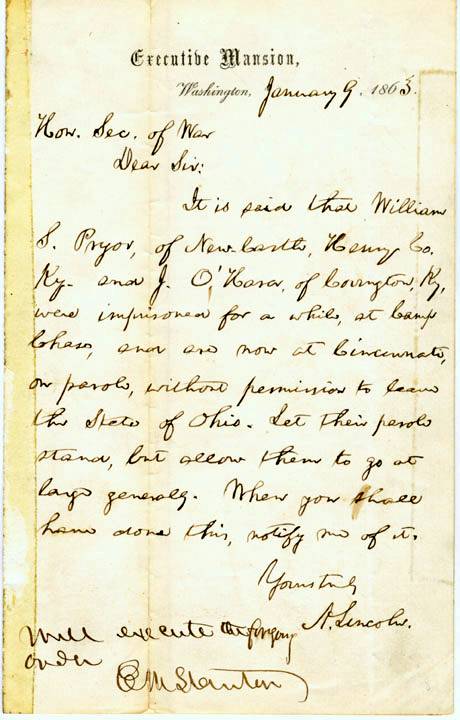
So there I was, about to turn off my computer a couple of days ago, and thinking about my great-grandfather Pryor. I had just written a small item about him for an attached web site. He has been dead almost a hundred years so there wasn’t much new with him. Anyway, I entered his name in the search spot in Google and wow! Up came a site for the sale of historical documents.
One of the documents for sale was a letter written at the Executive Mansion (of the President of the U.S.). The letter was written by Abraham Lincoln to Secretary of War Stanton about what to do with a couple of civilians who were in prison in Ohio.
One of the men was my great-grandfather. I knew he had been in prison at the behest of A. Lincoln but I didn’t know why. I always suspected it was because he had helped Confederate General John Hunt Morgan escape the Yankees in central Kentucky.
My great-grandfather did help Morgan, but the letter from Lincoln was written some eight months before Hunt had escaped! I had been wrong all these years about the reason for prison. Lincoln had tried by military court and imprisoned some 13,500 civilians in the North by the end of the War, so one more or less didn’t matter (KY was a neutral state).
Lincoln used the passive term when he wrote, “It is said that William S. Pryor is in prison . . .” He acted as if he didn’t know about it. But Lincoln’s good friend, Judge James Pryor was William S. Pryor’s fond uncle, and I bet Judge Jim leaned on Honest Abe a bit to let his favorite nephew out of the pokey. Abe, after all, was a very ordinary politician.
So I do not know why my great-grandfather was imprisoned. But I do know he was a lawyer and a good one from the size of his 1859 mansion.
Lawyers tend to lose their law licenses if they have been sent to prison, but imprisonment by Lincoln was reason for a merit badge, not a disbarment, and after the war my great-grandfather not only continued to practice law but also was made a circuit court judge. He served on the circuit for three years and then was appointed Chief Justice of the State Supreme Court. He was on that bench for twenty-six years, longer than anybody before or after.
Evidently, prison was a only graduate course.
I still want to find out what pretext was used to imprison him, other than the fact that he was a Democrat and Lincoln was a Republican. Kentucky politics can get rough.
Abraham Lincoln,John Hunt Morgan, Civil War,Kentucky,E.W. Stanton
Tuesday, November 21, 2006
End of an Obsession
Subscribe to:
Posts (Atom)