When one is 70 or so, he or she should be free from the need to move from one house to another. That freedom ought to be up there with four freedoms that President Roosevelt named in 1941: freedom from fear, hunger, and so on.
As I was deciding what to take with me a couple years ago for my move to Fullerton from Arcadia, California, I had to choose from among many books. Even worse, I had to decide where to throw out many books. It is getting hard to find places that will take them, ecologically sound places.
Now that I look back on the ordeal, I am impressed by the subject matter of books that I did not take. Not feeling an affinity for those topics indicates a certain freedom from the past.
Failed “isms” need not always be part of one’s psyche or one’s library.
For instance, many books on Communism are gone. I am not a Communist but an economist by education. I had to study Communism in college. Communism has proven itself to be a failure and is found only on college campuses these days (in the United States).
Likewise, books on existentialism are gone from my shelves. Existentialism was a “cute” philosophy of the past. My, how we longed for cuteness and novelty. Novels and philosophic writings used to be crammed full of existential thought. Histories were re-written to reveal existential roots of leaders. And in days when I was young, God was really, really dead—and for the last time, too. RIP.
My books on psychotherapy and its originator, Siggy Freud, are all gone. At one time I was a true believer. And why not? I was brought up with it. Contemporary literature was chock-full of the language of Freud. Movies of the 1930’s and 1940’s were full of deeply significant psychological talk. Actually, our movies were rather heavy-handed in their propaganda sieges. They would be embarrassingly obvious now. Psychologists became priests and even today are consulted by judges in criminal cases. They are asked to predict human behavior, but are not held accountable when they are proven wrong.
Biographers felt they had to psychoanalyze their subjects. They took a rough cut even though they did not live in the times of their subjects and even though they were totally unqualified as psychologists and even though many psychologists they knew were equally unqualified to practice. (Among my souvenirs is a cancelled check written to a psychologist who talked to my son. This practitioner had his license pulled, for his unethical work with a member of the Beach Boys musical group.)
Few words about Freud are heard these days. Psychologists are trying all kinds of other treatment techniques for obvious reasons. A study reported on in Scientific American showed that the three main therapy methods recorded some kind of improvement about one third of the time. It did not matter which method was used. Movie makers and novelists have given up on Freud. So have I. Perhaps, by this time Freud, is really, really, dead. RIP.
When I write about people I try to avoid psychological terms and any form of psychological analysis. I am happy to admit that I am not qualified to dabble in the black art of psychology.
What else is gone from my library? Not the really fine literature of our culture. I still have that. And I still have the essays of early economists. They were political thinkers as well as economists.
I threw out all the old computer books. But I kept bird books and well-written histories. Bartlett and Roget are still on my shelves. Many astronomy books have been surpassed by new discoveries and all my atlases also have been made obsolete. Dictionaries have changed, but I still have a few computer programming books. I occasionally write a program just to see if I can still do it.
And I have an old bible or two. An occasional death of the Creator has not discouraged me.
At the last count, two thirds of my personal library is gone. Dusty, faithful old friends are being reprocessed somewhere into, I hope, new books so they can spread a better truth than I have known—truth that can last more than a few years. And I hope they can avoid cuteness.
Culture Books Communism existentialism psychotherapy Freud
Friday, March 31, 2006


Monday, March 27, 2006
The Citibank Saga Continues
In my last post to this blog I reported on the UPS (Brown) situation that compounded my Citibank ATM card problems.
Citibank arbitrarily shut off my ATM card and shut me out of computer access to my bank account. I have heard that I was only one out of many more that this happened to . When I told Citibank that the new card they sent my was lost in the bowels of UPS somewhere, and in spite of what was reported I did not receive it or sign for it. So they sent another one to my local branch bank.
My local branch told me the card had arrived, so I went see them and pick up the card. I was told that the card was ready to go and already had my pin number included.
But when the teller at the ban tried to activate the card, it would not work. She had a bad cold and coughed a lot and was not feeling well. After many attempts, she had me call Citibank on the bank’s phone. They had a direct line to Calcutta. Either that or the guy on the other end of the line was doing a perfect imitation of the actor Ben Kingsley in the movie, Ghandi.
Ghandi could not activate my card, either. He worked and worked on it some 10,000 miles away, interrupting the process to talk to his supervisor a couple of times and then pronounced the job as completed. He wished me a nice day and ended the conversation. I asked the teller to test his handiwork. She could not get the card to work.
The teller and I spent some five minutes on my replacement card. This required many applications of her finger to a pad that was checking her fingerprint. That check was unreliable as well. But she finally pronounced the job as done. I went outside the bank to its ATM window and fearfully placed the card in its slot.
It worked! Despite all UPS and Citibank could do, I actually possessed an ATM card that worked.
Then I had to go home and call a special telephone number that would gain me access to my bank account via the Internet. It was back to India again, only this time with a female Ben Kingsley who had a high voice and spoke very fast. Ms Ghandi and I were able, after a long time to break the code so that I could access my own bank account.
All was in order with my finances. And I am developing some fluency with Hindi.
UPS Shipping Citibank Culture
Citibank arbitrarily shut off my ATM card and shut me out of computer access to my bank account. I have heard that I was only one out of many more that this happened to . When I told Citibank that the new card they sent my was lost in the bowels of UPS somewhere, and in spite of what was reported I did not receive it or sign for it. So they sent another one to my local branch bank.
My local branch told me the card had arrived, so I went see them and pick up the card. I was told that the card was ready to go and already had my pin number included.
But when the teller at the ban tried to activate the card, it would not work. She had a bad cold and coughed a lot and was not feeling well. After many attempts, she had me call Citibank on the bank’s phone. They had a direct line to Calcutta. Either that or the guy on the other end of the line was doing a perfect imitation of the actor Ben Kingsley in the movie, Ghandi.
Ghandi could not activate my card, either. He worked and worked on it some 10,000 miles away, interrupting the process to talk to his supervisor a couple of times and then pronounced the job as completed. He wished me a nice day and ended the conversation. I asked the teller to test his handiwork. She could not get the card to work.
The teller and I spent some five minutes on my replacement card. This required many applications of her finger to a pad that was checking her fingerprint. That check was unreliable as well. But she finally pronounced the job as done. I went outside the bank to its ATM window and fearfully placed the card in its slot.
It worked! Despite all UPS and Citibank could do, I actually possessed an ATM card that worked.
Then I had to go home and call a special telephone number that would gain me access to my bank account via the Internet. It was back to India again, only this time with a female Ben Kingsley who had a high voice and spoke very fast. Ms Ghandi and I were able, after a long time to break the code so that I could access my own bank account.
All was in order with my finances. And I am developing some fluency with Hindi.
UPS Shipping Citibank Culture
Monday, March 20, 2006
What Can Brown Do To You, Today?
Last week, Citibank suddenly tied up my ATM card and didn't let me know. So I went into the closest bank and inquired about it. They talked to supervisors and finally told me I would have to call my branch bank in Arcadia. So I called them on an 800 number, probably in Calcutta. There they switched me off to a supervisor. She told me my card was somehow involved in a fraud. A friend later told me that he saw in the newspaper and on TV that Citibank had screwed up a lot of accounts with a stupid move and that I was one of the losers. I don’t know, yet.
I tried to get into my bank account on the Internet but they had blocked that, too. So I didn't know how much money I was missing, if any.
Citibank offered to send out a card by UPS and that I should be at home all day to get it on Friday. Nothing happened on Friday so I called them the following Monday. They said their records showed UPS delivered the card and that I had signed for it. I said FRAUD and they better get on it.
Citibank offered to get a card to my local bank on Wednesday. But it would have another number. I said fine and then called UPS (good ole Brown). The guy I talked to had an attitude. He said in his arrogant way that their records showed the card was delivered somewhere on Thursday, not Friday, and picked back up that evening. It looked to him that it had been delivered to the wrong house. He added that the driver had put my name on the delivery slip. He did not know where the card was but at least it had the right address on it. He told me to tell Citibank to put a tracer on it.
I knew that the card was dead and that no one had tried to activate it. So I told the Brown guy what I was going to do--I was not going to tell Citibank and I was going to write about them in my latest blog on the Internet. And that he could do the tracing himself, if he wanted to. He ordered me to have a nice day.
Should we beware the military-industrial complex? No, the banking-shipping complex.
The saga continues.
UPS Shipping Citibank Culture
I tried to get into my bank account on the Internet but they had blocked that, too. So I didn't know how much money I was missing, if any.
Citibank offered to send out a card by UPS and that I should be at home all day to get it on Friday. Nothing happened on Friday so I called them the following Monday. They said their records showed UPS delivered the card and that I had signed for it. I said FRAUD and they better get on it.
Citibank offered to get a card to my local bank on Wednesday. But it would have another number. I said fine and then called UPS (good ole Brown). The guy I talked to had an attitude. He said in his arrogant way that their records showed the card was delivered somewhere on Thursday, not Friday, and picked back up that evening. It looked to him that it had been delivered to the wrong house. He added that the driver had put my name on the delivery slip. He did not know where the card was but at least it had the right address on it. He told me to tell Citibank to put a tracer on it.
I knew that the card was dead and that no one had tried to activate it. So I told the Brown guy what I was going to do--I was not going to tell Citibank and I was going to write about them in my latest blog on the Internet. And that he could do the tracing himself, if he wanted to. He ordered me to have a nice day.
Should we beware the military-industrial complex? No, the banking-shipping complex.
The saga continues.
UPS Shipping Citibank Culture
Tuesday, March 14, 2006
Driving Miss Economy
Ask most people what is driving the economy and they will guess that it is the computer revolution. It seems that every day there is some new invention or way of handling information that retires an old device and makes necessary a new, expensive device. VoIP and MP3s are examples of newer devices.
But there is another economic mover and shaker that lurks in the background. Our nation’s inventory of houses is maturing. We don’t throw houses away like we do old computers. We upgrade them. Home Depot and Lowes-type stores are not popular just because they are fast-moving retailers. They are popular because they are filling a need caused by the aging of our nation’s houses.
Thanks to standardization of construction dimensions (2X4 construction is about the same in every state and door heights are usually the same), an innovation for repair or upgrading in New York is often equally useful in Texas. In other words, it pays to innovate because there is a large volume of potential customers. It seems that every week, my local home store offers a new tool or plumbing or electrical or bracket or insulation device that is easily handled by the average do-it-yourselfer. This continuous upgrading for the upgraders is very good for our economy. Because of the continuous revolution in electronics, people have jobs and the money to upgrade their homes.
If that weren’t enough, specialists are springing up with new products for those jobs where a do-it-yourselfer, can’t. Some companies will replace all the plumbing in your house; others will replace all your windows and doors. They do their jobs quickly and efficiently and that is all they do. Specialization often results in lower prices. Generally the replacements are better and use less energy. This activity is sparking the economy, too.
Our revolution in communication allows new ideas to flow quickly and easily around the country and the world. It allows a kind of marketing in which people read about a new product and then demand it from their local retailer.
If all this progress keeps up we may be able to afford an extra gallon of gasoline.
Economics culture business Do-it-yourself Housing
But there is another economic mover and shaker that lurks in the background. Our nation’s inventory of houses is maturing. We don’t throw houses away like we do old computers. We upgrade them. Home Depot and Lowes-type stores are not popular just because they are fast-moving retailers. They are popular because they are filling a need caused by the aging of our nation’s houses.
Thanks to standardization of construction dimensions (2X4 construction is about the same in every state and door heights are usually the same), an innovation for repair or upgrading in New York is often equally useful in Texas. In other words, it pays to innovate because there is a large volume of potential customers. It seems that every week, my local home store offers a new tool or plumbing or electrical or bracket or insulation device that is easily handled by the average do-it-yourselfer. This continuous upgrading for the upgraders is very good for our economy. Because of the continuous revolution in electronics, people have jobs and the money to upgrade their homes.
If that weren’t enough, specialists are springing up with new products for those jobs where a do-it-yourselfer, can’t. Some companies will replace all the plumbing in your house; others will replace all your windows and doors. They do their jobs quickly and efficiently and that is all they do. Specialization often results in lower prices. Generally the replacements are better and use less energy. This activity is sparking the economy, too.
Our revolution in communication allows new ideas to flow quickly and easily around the country and the world. It allows a kind of marketing in which people read about a new product and then demand it from their local retailer.
If all this progress keeps up we may be able to afford an extra gallon of gasoline.
Economics culture business Do-it-yourself Housing
Friday, March 10, 2006
Bonds Between China and the USA
Recently I heard someone on radio say that the Chinese are financing America’s debt and that we were in trouble if they suddenly quit doing it. The idea was that a parent was going to “cut us off” without a cent. But the Chinese are not doing us a favor as a fond parent might. They are making an investment in the most business-like sense. It pays for them to invest in America’s bonds.
When a person says China is financing our debt, he is really saying that the Chinese bought a great deal of the bonds issued by the American government. The Chinese made an investment. If they “suddenly quit” financing our debt, how will they do it? One of two ways, maybe a bit of both. 1), China will sell some existing bonds, and 2), China will hold other bonds to maturity but will not buy more when those bonds mature.
In the first case, the Chinese will sell their bonds to someone else, just as they would any other investment. They are unwilling to take a loss--they made the investment in America for safety and a likely return on their investment. If they dump a lot of bonds at once they face a drop in the price of those bonds. Also, when they sell their bonds they will have to invest in some other government’s bonds. Lots luck to them.
America, with all its Chinese-owned bonds suddenly dumped on the market, will see lower priced bonds which means a higher interest rate in the future. However, there will be little immediate impact. Someone will buy the bonds and America will not be involved in the transaction.
In the second case (when China suddenly stops financing America’s debt) as Chinese-owned bonds mature China will buy no more of them. It will invest somewhere else. Again, lots of luck. China will buy another nation’s bonds, out-bidding someone else and that other person or nation will buy America’s bonds.
In order to sell a new issue of bonds, America may have to raise interest rates. In the today’s world, which seems to be awash in capital, the rise in interest rates will not be pleasant but will not be overwhelmingly large, either.
So do economists quake at the thought of China suddenly refusing to “finance America’s debt”? None that I know of, for the reasons given. And, if they are old enough they recall a time twenty years ago when people were afraid that Japan would suddenly refuse to finance America’s debt. Today’s pronouncement about our debt has a familiar sound and when decoded, it means “go back to school and take an economics class.”
economics government politics Current Affairs News Media
When a person says China is financing our debt, he is really saying that the Chinese bought a great deal of the bonds issued by the American government. The Chinese made an investment. If they “suddenly quit” financing our debt, how will they do it? One of two ways, maybe a bit of both. 1), China will sell some existing bonds, and 2), China will hold other bonds to maturity but will not buy more when those bonds mature.
In the first case, the Chinese will sell their bonds to someone else, just as they would any other investment. They are unwilling to take a loss--they made the investment in America for safety and a likely return on their investment. If they dump a lot of bonds at once they face a drop in the price of those bonds. Also, when they sell their bonds they will have to invest in some other government’s bonds. Lots luck to them.
America, with all its Chinese-owned bonds suddenly dumped on the market, will see lower priced bonds which means a higher interest rate in the future. However, there will be little immediate impact. Someone will buy the bonds and America will not be involved in the transaction.
In the second case (when China suddenly stops financing America’s debt) as Chinese-owned bonds mature China will buy no more of them. It will invest somewhere else. Again, lots of luck. China will buy another nation’s bonds, out-bidding someone else and that other person or nation will buy America’s bonds.
In order to sell a new issue of bonds, America may have to raise interest rates. In the today’s world, which seems to be awash in capital, the rise in interest rates will not be pleasant but will not be overwhelmingly large, either.
So do economists quake at the thought of China suddenly refusing to “finance America’s debt”? None that I know of, for the reasons given. And, if they are old enough they recall a time twenty years ago when people were afraid that Japan would suddenly refuse to finance America’s debt. Today’s pronouncement about our debt has a familiar sound and when decoded, it means “go back to school and take an economics class.”
economics government politics Current Affairs News Media
Monday, March 06, 2006
Teachers and Personal Opinions
Several years ago, as I was passing the doorway to a science classroom, a seventh grader said, “Hello, Mr. Fiske, you old fart.”
I chuckled inside, but managed a stern face and said, “Come on, Bobby, let’s go to the office.” I wasn’t Bobby’s teacher at the moment, but I took charge of him anyway and marched him to the school office. There, I filled out a referral slip, on which I wrote, “Bobby called me, in front of about 20 students, ‘An old fart.’ While he may be right, I thought his choice of words was inappropriate for Dana Middle School.”
Bobby got a detention and was told to apologize. When he did I broke a rule and put my arm around him, saying “Bobby, I don’t mind what you said. Everyone is entitled to his own opinion. Just don’t say words like that in front of other students.” We became good friends after that. I am sure he did not change his opinion. But the office personnel had a lot of fun with the referral.
Having taught graduate and undergraduate students in college and all grades from six through twelve in public schools, I have loads of experience with political and other opinions in the classroom. My inner person guided me with a sense of fair play. That is, if I expressed an opinion, I gave the opposite view as well. No one knew how I voted in elections.
That is why I (and other teachers should be) was so offended by the actions of one Jay Bennish of the Overland High School in the Denver, Colorado area. In his lectures to tenth graders, this teacher expressed a great deal of anti-Bush, anti-U.S.A. venom with no opportunity for rebuttal, according to tapes made in his classroom. The remarks appeared to be off-topic as well as ‘off the wall.’ There was no fair play involved.
It is my opinion (others may disagree) that the American tradition allows for dissent and for both sides of an argument to be presented, even at the tenth grade level. This is especially important in America’s public school system.
Mr. Bennish’s lawyer argued on a TV news program that the teacher had the right of free speech. Not so. What if Mr. Bennish used his 55 minutes with students to preach the Gospel? He would find himself out of the school district on his ear. And he should be. He is a geography teacher.
So, okay, I was brought up in the Louisville, KY school district where teachers utilized fair play every day. Maybe other school districts are not so inclined. But I suspect that fair-minded people can be found everywhere.
Maybe I am just an idealist.
Teachers culture
education Politics Kentucky Louisville
I chuckled inside, but managed a stern face and said, “Come on, Bobby, let’s go to the office.” I wasn’t Bobby’s teacher at the moment, but I took charge of him anyway and marched him to the school office. There, I filled out a referral slip, on which I wrote, “Bobby called me, in front of about 20 students, ‘An old fart.’ While he may be right, I thought his choice of words was inappropriate for Dana Middle School.”
Bobby got a detention and was told to apologize. When he did I broke a rule and put my arm around him, saying “Bobby, I don’t mind what you said. Everyone is entitled to his own opinion. Just don’t say words like that in front of other students.” We became good friends after that. I am sure he did not change his opinion. But the office personnel had a lot of fun with the referral.
Having taught graduate and undergraduate students in college and all grades from six through twelve in public schools, I have loads of experience with political and other opinions in the classroom. My inner person guided me with a sense of fair play. That is, if I expressed an opinion, I gave the opposite view as well. No one knew how I voted in elections.
That is why I (and other teachers should be) was so offended by the actions of one Jay Bennish of the Overland High School in the Denver, Colorado area. In his lectures to tenth graders, this teacher expressed a great deal of anti-Bush, anti-U.S.A. venom with no opportunity for rebuttal, according to tapes made in his classroom. The remarks appeared to be off-topic as well as ‘off the wall.’ There was no fair play involved.
It is my opinion (others may disagree) that the American tradition allows for dissent and for both sides of an argument to be presented, even at the tenth grade level. This is especially important in America’s public school system.
Mr. Bennish’s lawyer argued on a TV news program that the teacher had the right of free speech. Not so. What if Mr. Bennish used his 55 minutes with students to preach the Gospel? He would find himself out of the school district on his ear. And he should be. He is a geography teacher.
So, okay, I was brought up in the Louisville, KY school district where teachers utilized fair play every day. Maybe other school districts are not so inclined. But I suspect that fair-minded people can be found everywhere.
Maybe I am just an idealist.
Teachers culture
education Politics Kentucky Louisville
Thursday, March 02, 2006
Bugging the CIA
In the past I have done some very special research for my books. By “special “ I mean to say research that cannot be found by the average person. I required help from the CIA and the FBI.
Under the FOIA (Freedom of Information Act) a researcher can find all kind of useful information. For instance, I had a cousin who traipsed all over Europe after WWII, sometimes in Iron Curtain countries, for fun and profit. He owned several companies that dealt with the Federal Government, too. So I was sure the FBI had a file on him. The CIA, too. But I was more interested in his domestic activities, so I did not ask the CIA for information.
At first, the FBI only wanted proof that my subject was really dead. So I had to round up an obituary from 1967. And then the ___ hit the fan.
It just so happened that when I asked for information on my cousin, the Clinton Administration was found to have 900 private FBI files of Republican opponents and a big, embarrassing stink ensued. The FBI became very skittish about releasing information. They stalled and stalled. But after a couple of years I got a few redacted papers. They concerned mostly Jimmy Hoffa, the late (and still missing) president of the Teamsters. It seems the FBI was investigating my cousin’s companies to see if the Teamsters had been shaking down them down. The Teamsters were clean.
Well, now I am investigating another person, not a cousin, who may have been involved in “Operation Paperclip,” right after WWII. This was not a popular Truman program that allowed the U.S. to seize German papers, equipment, and scientists involved in rocket science and in atomic energy projects. If the scientists were Nazis, then their records were cleaned up. The purpose was a) to help the U.S. and b) to keep the information and scientists out of Russian hands.
On paper, my subject reported to Dr. Carl David Anderson of CalTech. Anderson was the man who turned down control of the Manhattan Project in favor of his friend, J. Robert Oppenheimer. In reality, my subject reported directly to President Roosevelt first and then to President Truman. He was a friendly spy among the presidents’ advisors.
I have requested information by FAX from both the FBI and the CIA. Fortunately, my subject’s widow is alive and alert, and she is quite anxious to find out what her husband was really up to during years as WWII wound down and the Cold War sprang up. He was never allowed to tell her.
And yes, the FBI has responded by asking for proof of the death of my subject. They will not accept their own government’s Social Security Death Index as proof of death. Maybe they do not trust the government.
Science writing Government Freedom of Information Act CalTech Operation Paperclip FBI CIA
Under the FOIA (Freedom of Information Act) a researcher can find all kind of useful information. For instance, I had a cousin who traipsed all over Europe after WWII, sometimes in Iron Curtain countries, for fun and profit. He owned several companies that dealt with the Federal Government, too. So I was sure the FBI had a file on him. The CIA, too. But I was more interested in his domestic activities, so I did not ask the CIA for information.
At first, the FBI only wanted proof that my subject was really dead. So I had to round up an obituary from 1967. And then the ___ hit the fan.
It just so happened that when I asked for information on my cousin, the Clinton Administration was found to have 900 private FBI files of Republican opponents and a big, embarrassing stink ensued. The FBI became very skittish about releasing information. They stalled and stalled. But after a couple of years I got a few redacted papers. They concerned mostly Jimmy Hoffa, the late (and still missing) president of the Teamsters. It seems the FBI was investigating my cousin’s companies to see if the Teamsters had been shaking down them down. The Teamsters were clean.
Well, now I am investigating another person, not a cousin, who may have been involved in “Operation Paperclip,” right after WWII. This was not a popular Truman program that allowed the U.S. to seize German papers, equipment, and scientists involved in rocket science and in atomic energy projects. If the scientists were Nazis, then their records were cleaned up. The purpose was a) to help the U.S. and b) to keep the information and scientists out of Russian hands.
On paper, my subject reported to Dr. Carl David Anderson of CalTech. Anderson was the man who turned down control of the Manhattan Project in favor of his friend, J. Robert Oppenheimer. In reality, my subject reported directly to President Roosevelt first and then to President Truman. He was a friendly spy among the presidents’ advisors.
I have requested information by FAX from both the FBI and the CIA. Fortunately, my subject’s widow is alive and alert, and she is quite anxious to find out what her husband was really up to during years as WWII wound down and the Cold War sprang up. He was never allowed to tell her.
And yes, the FBI has responded by asking for proof of the death of my subject. They will not accept their own government’s Social Security Death Index as proof of death. Maybe they do not trust the government.
Science writing Government Freedom of Information Act CalTech Operation Paperclip FBI CIA
Thursday, February 23, 2006
POW in the War Between the Sexes
Having grown up with two mean older brothers and no sisters or close female first cousins, I was brought up with a very scant knowledge of girls and women. But I was smart from the beginning; I didn’t understand females and admitted it. Despite my groveling and deference I grew up suffering at their hands. Women can detect even the slightest fear and will take advantage of any male who shows it.
Women teachers seemed to single me out for disapproval. No matter how hard I tried to please them, they came at me with a look of extreme displeasure, not unlike Representative Nancy Pelosi, who looks like the “before” picture in an ad for hemorrhoid sufferers.
In industry the person who caused me the most trouble was a woman named Mary Ann Something. She was bright, a very good manager and a sharp union steward, while I represented management. I could have a terrible day, but it always got worse when Mary Ann appeared in my office. I once tried to enlist Mary Ann in the ranks of management (we could have used a higher level of manager) but she would not sell out her Labor ideals and bore down even harder on me. No good deed goes unpunished.
In my personal life I have had two wives, a daughter, a step-daughter, a daughter-in-law and several granddaughters but my understanding of females has not improved because of them.
I have even taught in public school, where I often told my charges that women can do anything but play left tackle for the Detroit Lions and most men can’t do that, either. And I meant it. I wanted to be on record as pro-female when they took over the world. But my pretty students took this comment as mere groveling and wrote beside my name in their book of executions, “head of the line.”
My only saving grace is that I have a very good talent for fixing things. I would be pushing up daisies right now, if it were not for the day, early in my substitute teaching career, when a seventh grade girl I didn’t know brought me a handful of parts to her eyeglasses. It was during a test and she was losing time, so I quickly reached into my briefcase and bought out a tiny screwdriver and some very small screws. I had her glasses put back together again in less than a minute. She told other girls and my life was spared from that moment on.
There were several widows on my block and I was allowed to help them with electrical problems and plumbing disasters. That way I managed to continue in not good but tolerable standing with the female community. But it took lots of work to stay at that level.
The Bible says I came into this world with nothing. Nothing, that is, but a minus quantity of points with the opposite sex, and I have been trying to break even all my life. Like Sisyphus with his task of rolling a huge rock up a hill, I have been given the task of understanding women and failed every day.
culture Life Women War between the sexes sisyphus Humor
Women teachers seemed to single me out for disapproval. No matter how hard I tried to please them, they came at me with a look of extreme displeasure, not unlike Representative Nancy Pelosi, who looks like the “before” picture in an ad for hemorrhoid sufferers.
In industry the person who caused me the most trouble was a woman named Mary Ann Something. She was bright, a very good manager and a sharp union steward, while I represented management. I could have a terrible day, but it always got worse when Mary Ann appeared in my office. I once tried to enlist Mary Ann in the ranks of management (we could have used a higher level of manager) but she would not sell out her Labor ideals and bore down even harder on me. No good deed goes unpunished.
In my personal life I have had two wives, a daughter, a step-daughter, a daughter-in-law and several granddaughters but my understanding of females has not improved because of them.
I have even taught in public school, where I often told my charges that women can do anything but play left tackle for the Detroit Lions and most men can’t do that, either. And I meant it. I wanted to be on record as pro-female when they took over the world. But my pretty students took this comment as mere groveling and wrote beside my name in their book of executions, “head of the line.”
My only saving grace is that I have a very good talent for fixing things. I would be pushing up daisies right now, if it were not for the day, early in my substitute teaching career, when a seventh grade girl I didn’t know brought me a handful of parts to her eyeglasses. It was during a test and she was losing time, so I quickly reached into my briefcase and bought out a tiny screwdriver and some very small screws. I had her glasses put back together again in less than a minute. She told other girls and my life was spared from that moment on.
There were several widows on my block and I was allowed to help them with electrical problems and plumbing disasters. That way I managed to continue in not good but tolerable standing with the female community. But it took lots of work to stay at that level.
The Bible says I came into this world with nothing. Nothing, that is, but a minus quantity of points with the opposite sex, and I have been trying to break even all my life. Like Sisyphus with his task of rolling a huge rock up a hill, I have been given the task of understanding women and failed every day.
culture Life Women War between the sexes sisyphus Humor
Wednesday, February 15, 2006
Rocket Science Secrets
Nearly all of them are dead now. So I guess I can say a little about them and the adventures they described. I learned about them in a church, of all places. The church sponsored an autobiographical writer’s club and I was asked to join. Elderly ladies outnumbered us men, and their stories were no less interesting because they were women. However, it was stories about their families that caught my attention. Who could have expected to hear about the rocket science and its secrets that bound three of the ladies?
Over a period of years with this group I learned some of the secrets and even a tale of horror. For reasons I cannot tell, I was asked not to reveal their names. I understand why, but for the most part they are all gone now, and I can tell a little of what I learned.
The first story was one of horror and destitution. A German lady in the group, Heidi, revealed her story. She was raised in Transylvania, Romania as part of a German village with an almost ideal existence until WWII. Her uncle was a rocket scientist and professor whom I will call Hermann Schmidt. He was not a Nazi but his student Werner Von Braun, was. The little family managed to get through the War with deprivation, but they got through somehow. Then at the end, Russians came through, setting up a Communist government. The leaders of this government dispossessed Heidi’s family. The Russians took all German children of working age with them into Russia as virtual slaves to work on Russian farms. Heidi, a pretty girl then, worked a year or so in Russia and escaped first to East Germany and then to West Germany. Later, she went to Canada and ventured into the United States. Even now, Heidi is trying to locate the rest of her family in Europe.
The second story concerns a widow whose husband died just before I became a member of the writer’s group. A. L. (Bill) Belken is the name I have given him. He traveled as a civilian but had a high military status. Over a period of years I learned that he had worked directly for Presidents Roosevelt and Truman in Europe. I have seen personal commendations from those presidents for the work that Bill did, but I do not know what he did. The libraries of these presidents are silent on the subject. The National Archive says it has never heard of him.
All I could find from his widow was that he traveled extensively in Europe during and after WWII. Oh, there was one thing: when the P-38 plane was developed, it shook drastically. The two engines drove it were shaking the plane apart. Bill, with some kind of connection to Cal Tech, was asked to take a look at the problem. He suggested that the engineers reverse the rotation of one of the engines. That solved the problem and the P-38 was a great offensive weapon during the war.
I also learned that Bill was interested in JATO, or Jet Assisted Take Off of airplanes, which put him solidly in the rocket science camp. That was a short program, but rockets were just beginning to come into their own. Was Bill also involved in “Operation Paperclip?” It is quite possible. Very little is said about that operation, even today. But I can say that this operation, begun under President Truman, was one in which German rocket scientists and their laboratories were collected by Western Allies before the Russians could get to them. If the scientists were also Nazis, then their records were cleaned up. Perhaps little is known about Bill because of his involvement in that program. It was not a popular one.
Finally, there is another story. A wife in the writer’s group had a husband who was a simple MD and had been one during WWII. I will call him Dr. Mike Moriarity, because he has to have a name. Mike was part of America’s space program. The secret is that he was present at all Russian space program events during the 1960’s. He was a good friend of Yuri Gagarin and other Russian space people. He was an invited guest at each event. I personally have seen photos of Mike and Yuri together. Mike’s wife told us and later Mike agreed as he attended our meetings, that he would suddenly disappear from the U.S. No one knew where he was. Well, almost no one knew. Certainly not his family. But the Russians knew. Mike was with them.
When Mike would return from one of his clandestine trips, he was interviewed by not one but two U. S. intelligence agencies. The Russians had to know that he was being interviewed. And Mike was not allowed to tell one agency what he had told the other. That is, each agency had to ask its own questions; they did not share a common report or interview Mike at the same time.
Now, if the U. S. had a representative at Russian space flights, was there reciprocity such that the Russians had a representative to watch our space flights? Very likely.
Eventually Mike phased out of the Space program but all that he did was kept secret. Even today, although Mike and his wife are dead, almost no one talks about his exploits in the space program. Most don’t know. But there are good reasons for not using his real name even as I write this.
Looking at this group of elderly writers, no one could have detected the common thread among their stories. They certainly did not recognize the thread until I pointed it out to them.
Rocket Science NASA Technology Yuri Gagarin Cal Tech Harry S Truman Werner Von Braun P-38 Transylvania Operation Paperclip
Over a period of years with this group I learned some of the secrets and even a tale of horror. For reasons I cannot tell, I was asked not to reveal their names. I understand why, but for the most part they are all gone now, and I can tell a little of what I learned.
The first story was one of horror and destitution. A German lady in the group, Heidi, revealed her story. She was raised in Transylvania, Romania as part of a German village with an almost ideal existence until WWII. Her uncle was a rocket scientist and professor whom I will call Hermann Schmidt. He was not a Nazi but his student Werner Von Braun, was. The little family managed to get through the War with deprivation, but they got through somehow. Then at the end, Russians came through, setting up a Communist government. The leaders of this government dispossessed Heidi’s family. The Russians took all German children of working age with them into Russia as virtual slaves to work on Russian farms. Heidi, a pretty girl then, worked a year or so in Russia and escaped first to East Germany and then to West Germany. Later, she went to Canada and ventured into the United States. Even now, Heidi is trying to locate the rest of her family in Europe.
The second story concerns a widow whose husband died just before I became a member of the writer’s group. A. L. (Bill) Belken is the name I have given him. He traveled as a civilian but had a high military status. Over a period of years I learned that he had worked directly for Presidents Roosevelt and Truman in Europe. I have seen personal commendations from those presidents for the work that Bill did, but I do not know what he did. The libraries of these presidents are silent on the subject. The National Archive says it has never heard of him.
All I could find from his widow was that he traveled extensively in Europe during and after WWII. Oh, there was one thing: when the P-38 plane was developed, it shook drastically. The two engines drove it were shaking the plane apart. Bill, with some kind of connection to Cal Tech, was asked to take a look at the problem. He suggested that the engineers reverse the rotation of one of the engines. That solved the problem and the P-38 was a great offensive weapon during the war.
I also learned that Bill was interested in JATO, or Jet Assisted Take Off of airplanes, which put him solidly in the rocket science camp. That was a short program, but rockets were just beginning to come into their own. Was Bill also involved in “Operation Paperclip?” It is quite possible. Very little is said about that operation, even today. But I can say that this operation, begun under President Truman, was one in which German rocket scientists and their laboratories were collected by Western Allies before the Russians could get to them. If the scientists were also Nazis, then their records were cleaned up. Perhaps little is known about Bill because of his involvement in that program. It was not a popular one.
Finally, there is another story. A wife in the writer’s group had a husband who was a simple MD and had been one during WWII. I will call him Dr. Mike Moriarity, because he has to have a name. Mike was part of America’s space program. The secret is that he was present at all Russian space program events during the 1960’s. He was a good friend of Yuri Gagarin and other Russian space people. He was an invited guest at each event. I personally have seen photos of Mike and Yuri together. Mike’s wife told us and later Mike agreed as he attended our meetings, that he would suddenly disappear from the U.S. No one knew where he was. Well, almost no one knew. Certainly not his family. But the Russians knew. Mike was with them.
When Mike would return from one of his clandestine trips, he was interviewed by not one but two U. S. intelligence agencies. The Russians had to know that he was being interviewed. And Mike was not allowed to tell one agency what he had told the other. That is, each agency had to ask its own questions; they did not share a common report or interview Mike at the same time.
Now, if the U. S. had a representative at Russian space flights, was there reciprocity such that the Russians had a representative to watch our space flights? Very likely.
Eventually Mike phased out of the Space program but all that he did was kept secret. Even today, although Mike and his wife are dead, almost no one talks about his exploits in the space program. Most don’t know. But there are good reasons for not using his real name even as I write this.
Looking at this group of elderly writers, no one could have detected the common thread among their stories. They certainly did not recognize the thread until I pointed it out to them.
Rocket Science NASA Technology Yuri Gagarin Cal Tech Harry S Truman Werner Von Braun P-38 Transylvania Operation Paperclip
Saturday, February 11, 2006
Remarkable Cure for Headaches
If you knew me, you would never guess that I am, or was, a frequent victim of headaches. These were not the “My headache is gone!” run-of-the-mill type headaches, either. These were blinding, splitting, go to bed without any dinner and no TV headaches.
One afternoon, while in the early throes of one of these killer aches, I decided to take a walk and get away from it all. Living in upper San Dimas, CA at the time, I hiked to the closest trail I could find that led into the mountains. It wasn’t long before a path took me around the side of a hill among the trees and away from all the noise of city life.
Suddenly I found myself alone. There was no noise except for the chirping of a mocking bird and the cawing of a crow. Maybe a bee was zipping from flower to flower. The silence was stunning. Also stunning was the pile in front of me that had been left by horse which had recently gone on ahead. I was, after all, on a bridle path.
I stopped for some reason and took it all in, looking for a way to step around the pile, so I could continue up the hillside. It was then that I experienced an olfactory hallucination! I do not know to this day how it happened, but suddenly I was transported back to my youth when I would leave the big city and visit a farm for a few days. The farmer had lots of horses. It was Bluegrass country, you see. Those were happy times when the only responsibility I had was to clean my shoes and report for meals on time.
Unfortunately, my mind didn’t spend much time in that place. The forlorn cry of a hawk wheeling overhead snapped me back to reality. When it did, I realized my headache had fled to other places. I was healed! Well, not permanently, but for the afternoon. I found that as headaches occurred in the succeeding months I could dispel them by walking up into the hills until I found another fresh pile. It had to be fresh green stuff, mind you. The brown material with a crust on it would not work. Eventually, I was able to go for weeks without a headache and I can now report that I have not had a really bad one for years. Talk about a miracle drug!
Since that time I have offered this miracle cure to others. It has been successfully used against three headache sufferers, one hernia and a hangnail. I am sure it would help most people.
I have offered this miracle compound to people in a local hospital, but my kindness was refused. You would be amazed at the numbers of people who don’t want to get well. But I am sure most readers are not like them.
Probably, since most people live so far from a race track, they cannot get their own supply of this nostrum. I am prepared to ship a one pound box without delay. There is a modest cost, of course. But I offer a warning: use it right away. The shelf life of this curative is very short.
Please let me know of your needs; I have connections at Santa Anita Race Track. The regular spring season is about over and it will not be until the fall when a fresh supply will return to Arcadia.
Humor Medicine Health and wellness Horse Racing
One afternoon, while in the early throes of one of these killer aches, I decided to take a walk and get away from it all. Living in upper San Dimas, CA at the time, I hiked to the closest trail I could find that led into the mountains. It wasn’t long before a path took me around the side of a hill among the trees and away from all the noise of city life.
Suddenly I found myself alone. There was no noise except for the chirping of a mocking bird and the cawing of a crow. Maybe a bee was zipping from flower to flower. The silence was stunning. Also stunning was the pile in front of me that had been left by horse which had recently gone on ahead. I was, after all, on a bridle path.
I stopped for some reason and took it all in, looking for a way to step around the pile, so I could continue up the hillside. It was then that I experienced an olfactory hallucination! I do not know to this day how it happened, but suddenly I was transported back to my youth when I would leave the big city and visit a farm for a few days. The farmer had lots of horses. It was Bluegrass country, you see. Those were happy times when the only responsibility I had was to clean my shoes and report for meals on time.
Unfortunately, my mind didn’t spend much time in that place. The forlorn cry of a hawk wheeling overhead snapped me back to reality. When it did, I realized my headache had fled to other places. I was healed! Well, not permanently, but for the afternoon. I found that as headaches occurred in the succeeding months I could dispel them by walking up into the hills until I found another fresh pile. It had to be fresh green stuff, mind you. The brown material with a crust on it would not work. Eventually, I was able to go for weeks without a headache and I can now report that I have not had a really bad one for years. Talk about a miracle drug!
Since that time I have offered this miracle cure to others. It has been successfully used against three headache sufferers, one hernia and a hangnail. I am sure it would help most people.
I have offered this miracle compound to people in a local hospital, but my kindness was refused. You would be amazed at the numbers of people who don’t want to get well. But I am sure most readers are not like them.
Probably, since most people live so far from a race track, they cannot get their own supply of this nostrum. I am prepared to ship a one pound box without delay. There is a modest cost, of course. But I offer a warning: use it right away. The shelf life of this curative is very short.
Please let me know of your needs; I have connections at Santa Anita Race Track. The regular spring season is about over and it will not be until the fall when a fresh supply will return to Arcadia.
Humor Medicine Health and wellness Horse Racing
Friday, February 03, 2006
A Tale of Two Justices
Educated in law at the knee of his uncle, William Samuel Pryor quickly mastered Greek and Latin. But he never obtained much in the way of a formal education the way most boys did. He was poor and had to help support his family. A brilliant student at law, he was ready to hang out his shingle before he was twenty-one years old. So his uncle and his friends got the state legislature about 1843 to pass a special act to allow Will that privilege.
Will was good at law and quickly built up a substantial practice in his town. Then President Lincoln had him tossed in jail in 1863. Will escaped and went to Canada. Returning to his practice in 1866, Will was appointed a judge of the circuit court. He rode his circuit for three years, became popular, and suddenly found himself chief justice of the highest court in Kentucky. He served on that bench longer than anyone before or after—sometimes chief justice and sometimes associate justice. To do so he had to give up his lucrative practice and accept an income that was about one third of what he could make in private practice. But Will loved the law.
It is easy to imagine that Justice Samuel Alito is much the same way. He was poor but found his way through good schools to serve his nation in the legal system. Justice Alito certainly could have commanded a much larger income than the government paid him. But he loved the law and wanted to serve as a judge.
Like William Samuel Pryor, Justice Samuel Alito had his own tribulations as he worked his way to his present position. In spite of his fine career and service as judge he was falsely accused of things just so someone could make points with his constituency. He had to sit and bear the unjustness of a few windbags in the Senate. But in the end he was finally approved by that body. Very likely it was his love for the law that kept him going through that grueling time.
Now that Justice Alito has found his place on the U. S. Supreme Court many of us wish hi well and we feel confident that a very good man has been selected. And that a few very sad examples of Senators have been exposed for what they are.
Somewhere in time William Samuel Pryor has a smile on his face.
Supreme Court Politics Kentucky Samuel Alito Current Affairs
Will was good at law and quickly built up a substantial practice in his town. Then President Lincoln had him tossed in jail in 1863. Will escaped and went to Canada. Returning to his practice in 1866, Will was appointed a judge of the circuit court. He rode his circuit for three years, became popular, and suddenly found himself chief justice of the highest court in Kentucky. He served on that bench longer than anyone before or after—sometimes chief justice and sometimes associate justice. To do so he had to give up his lucrative practice and accept an income that was about one third of what he could make in private practice. But Will loved the law.
It is easy to imagine that Justice Samuel Alito is much the same way. He was poor but found his way through good schools to serve his nation in the legal system. Justice Alito certainly could have commanded a much larger income than the government paid him. But he loved the law and wanted to serve as a judge.
Like William Samuel Pryor, Justice Samuel Alito had his own tribulations as he worked his way to his present position. In spite of his fine career and service as judge he was falsely accused of things just so someone could make points with his constituency. He had to sit and bear the unjustness of a few windbags in the Senate. But in the end he was finally approved by that body. Very likely it was his love for the law that kept him going through that grueling time.
Now that Justice Alito has found his place on the U. S. Supreme Court many of us wish hi well and we feel confident that a very good man has been selected. And that a few very sad examples of Senators have been exposed for what they are.
Somewhere in time William Samuel Pryor has a smile on his face.
Supreme Court Politics Kentucky Samuel Alito Current Affairs
Thursday, January 26, 2006
Wal-Mart Strikes Back
No doubt out of righteous indignation, the city fathers of Chicago rejected Wal-Mart in its attempt to install a store in the Windy City. So Wal-Mart set up its store about a block outside the city limits. According to reports, Wal-Mart has received some 25,000 job applications, most from Chicago people.
The great city has acceded to Union demands and in so doing, has lost a huge amount in taxes. But they have kept the Great Satan, Wal-Mart, at arm’s length. Good for them!
Even though all of us must agree that Wal-Mart is a great evil, we must also see that there is a parallel between today’s battle against Wal-Mart’s low prices and the battle against Fair Trade laws of the 1950’s and 1960’s.
In that earlier era (from about 1931), manufacturers set prices for which retailer had to sell their products. Pricing regulations were enforced by state laws. The Supreme Court said these laws were in violation of the Sherman Anti-trust Act. So in 1937 Congress, under pressure from lobbying groups passed a special act allowing price-fixing by manufacturers. The laws generally worked as long as numbers of manufacturers were few and the banded together to establish prices.
But pressure from discounters began developing cracks in the “Fair” Price structure. By the late 1950’s manufacturers began dropping their suggested pricing and in 1975 Congress woke up and killed Fair Pricing once again.
There was a great deal of consternation in the market place as the Fair Trade laws faded away. Rumors were passed around that “Jews from New York” were destroying the local little guy, and that service would be non-existent. Also, cities would fail if prices dropped causing a decline in tax revenues. Few seemed to realize that an increased volume of sales due to lower prices might very well increase total tax revenues.
Well, today the same arguments are being used in one form or another as Jews like the Walton family continue to find ways to deliver goods to the average guy at prices he can afford. Unfortunately for his detractors, Sam Walton is a Christian and there is nothing wrong with Jewish (or any other) people winning at retailing, anyway.
What appears to be at stake is not what the politicians are saying; it is their financial support from unions. That and the fact that some political people instinctively dislike the winners in society. You would think they would want to help Wal-Mart in its pattern of supplying the average guy with goods that only the rich used to have.
It’s a strange world. But it is made stranger because politicians are so terribly ignorant of even recent history.
Culture Wal-Mart Business Politics Conservatives Chicago
The great city has acceded to Union demands and in so doing, has lost a huge amount in taxes. But they have kept the Great Satan, Wal-Mart, at arm’s length. Good for them!
Even though all of us must agree that Wal-Mart is a great evil, we must also see that there is a parallel between today’s battle against Wal-Mart’s low prices and the battle against Fair Trade laws of the 1950’s and 1960’s.
In that earlier era (from about 1931), manufacturers set prices for which retailer had to sell their products. Pricing regulations were enforced by state laws. The Supreme Court said these laws were in violation of the Sherman Anti-trust Act. So in 1937 Congress, under pressure from lobbying groups passed a special act allowing price-fixing by manufacturers. The laws generally worked as long as numbers of manufacturers were few and the banded together to establish prices.
But pressure from discounters began developing cracks in the “Fair” Price structure. By the late 1950’s manufacturers began dropping their suggested pricing and in 1975 Congress woke up and killed Fair Pricing once again.
There was a great deal of consternation in the market place as the Fair Trade laws faded away. Rumors were passed around that “Jews from New York” were destroying the local little guy, and that service would be non-existent. Also, cities would fail if prices dropped causing a decline in tax revenues. Few seemed to realize that an increased volume of sales due to lower prices might very well increase total tax revenues.
Well, today the same arguments are being used in one form or another as Jews like the Walton family continue to find ways to deliver goods to the average guy at prices he can afford. Unfortunately for his detractors, Sam Walton is a Christian and there is nothing wrong with Jewish (or any other) people winning at retailing, anyway.
What appears to be at stake is not what the politicians are saying; it is their financial support from unions. That and the fact that some political people instinctively dislike the winners in society. You would think they would want to help Wal-Mart in its pattern of supplying the average guy with goods that only the rich used to have.
It’s a strange world. But it is made stranger because politicians are so terribly ignorant of even recent history.
Culture Wal-Mart Business Politics Conservatives Chicago
Thursday, January 12, 2006
Those Evil Corporations
There is a very interesting program on cable TV called “Fox News Watch.” At my house it is scheduled for Saturdays at 3:30 P.M. On the show, two fairly liberal folks and two fairly conservative folks give their views about the way news was handled in the previous week. There are usually four different “takes” on each event.
When the show was in its early stages, one of the Liberal pundits often began his comments with the observation, in effect, that the news media were owned by corporations and corporations were bad so they corrupted the news. His response was simplistic and monotonous. That may be the reason that he is no longer on the show.
But his argument lingers. I often hear arguments that begin with some connection to “evil corporations.” Proponents sound a bit like the early Rousseau, with a twist.
Jean Jacques Rousseau (1712-1778) was a French philosopher who argued early in his career that man is essentially good, a "noble savage" when in the "state of nature" (before the creation of civilization and society), and that good people are made unhappy and corrupted by their experiences in society. He viewed society as corrupt and thought that the furthering of society results in the continuing unhappiness of man. In other words, people are all right, but institutions are evil. Especially the Government.
These days, some folks agree with Rousseau without realizing it. But to them it is the corporations that are evil; but Government? Big Government is good.
But there is problem with this line of thought. Corporations are things—arrangements of people. Things are neither good nor evil. It is people in corporations who are either good or evil (or indifferent). So despite Rousseau, the argument goes back to people as it did in his day.
Rousseau’s evil “Society” was an arrangement of people. So are corporations. It seems to blame a mindless “arrangement” for today’s problems is somewhat like blaming the god Mars for a belligerent nature, or the god Bacchus for the hangover you get after a night of drinking.
But, some people are more religious than I am.
corporations culture politics conservatives Fox News Watch
When the show was in its early stages, one of the Liberal pundits often began his comments with the observation, in effect, that the news media were owned by corporations and corporations were bad so they corrupted the news. His response was simplistic and monotonous. That may be the reason that he is no longer on the show.
But his argument lingers. I often hear arguments that begin with some connection to “evil corporations.” Proponents sound a bit like the early Rousseau, with a twist.
Jean Jacques Rousseau (1712-1778) was a French philosopher who argued early in his career that man is essentially good, a "noble savage" when in the "state of nature" (before the creation of civilization and society), and that good people are made unhappy and corrupted by their experiences in society. He viewed society as corrupt and thought that the furthering of society results in the continuing unhappiness of man. In other words, people are all right, but institutions are evil. Especially the Government.
These days, some folks agree with Rousseau without realizing it. But to them it is the corporations that are evil; but Government? Big Government is good.
But there is problem with this line of thought. Corporations are things—arrangements of people. Things are neither good nor evil. It is people in corporations who are either good or evil (or indifferent). So despite Rousseau, the argument goes back to people as it did in his day.
Rousseau’s evil “Society” was an arrangement of people. So are corporations. It seems to blame a mindless “arrangement” for today’s problems is somewhat like blaming the god Mars for a belligerent nature, or the god Bacchus for the hangover you get after a night of drinking.
But, some people are more religious than I am.
corporations culture politics conservatives Fox News Watch
Sunday, January 01, 2006
Ugly Combination of Science and Politics
In an inappropriate mixture of science and politics, two experts in insect lore set aside the names for three slime-mold beetles. According to TLC News on the Internet, this first day of 2006, in an article called “Weird Science Tales of 2005” the names were adaptations of Bush, Cheney, and Rumsfeld, our President, Vice President, and Secretary of Defense. An example given for a slime beetle name was Agathidium bushi.
The story disappeared from the Internet within a few hours. If true, it appeared unprofessional and cowardly. There is no way a person can protect himself from this kind of childish prank. It doesn't matter which political party is involved, either.
But on another level, mixing science and politics can be rather devastating. When Fascist scientists determined that “survival of the fittest” meant eliminating the weak (minorities), it took a long time for people to realize there was no science in such thinking. Many German citizens thought nothing of killing Gypsies and Jews and anyone else they deemed “weak,” or less fit than they thought themselves to be.
The study of Eugenics, which had many well-known followers and a “scientific” basis for purifying the human race, resulted in harmful actions. It was nutty, of course but people believed in it for years. Some probably still do.
Communist scientific theoreticians clearly saw economic cycles that no one else could find. They used these “facts” to justify all kinds of monstrous behavior. Psychology, a weak science at best, was used for mind control. If that didn’t work, a frontal lobotomy might be called for. After all, people weren’t bad, they just needed an adjustment.
Science and politics can be an unwise and unjust combination. It would be well if we ordinary citizens could learn to spot such alliances when they occur. Perhaps the scientist/politicians involved could obtain an "adjustment."
science politics culture Conservativism fascism eugenics
The story disappeared from the Internet within a few hours. If true, it appeared unprofessional and cowardly. There is no way a person can protect himself from this kind of childish prank. It doesn't matter which political party is involved, either.
But on another level, mixing science and politics can be rather devastating. When Fascist scientists determined that “survival of the fittest” meant eliminating the weak (minorities), it took a long time for people to realize there was no science in such thinking. Many German citizens thought nothing of killing Gypsies and Jews and anyone else they deemed “weak,” or less fit than they thought themselves to be.
The study of Eugenics, which had many well-known followers and a “scientific” basis for purifying the human race, resulted in harmful actions. It was nutty, of course but people believed in it for years. Some probably still do.
Communist scientific theoreticians clearly saw economic cycles that no one else could find. They used these “facts” to justify all kinds of monstrous behavior. Psychology, a weak science at best, was used for mind control. If that didn’t work, a frontal lobotomy might be called for. After all, people weren’t bad, they just needed an adjustment.
Science and politics can be an unwise and unjust combination. It would be well if we ordinary citizens could learn to spot such alliances when they occur. Perhaps the scientist/politicians involved could obtain an "adjustment."
science politics culture Conservativism fascism eugenics
Wednesday, December 28, 2005
What Fools These Generals Be!
While doing research for my history of part of WWII, I came across a book that was written recently by a journalist (as opposed to a historian). It did not take me long to realize that the author seemed to think U.S. generals were buffoons while German generals were a breed apart. The author, of course, armed with sixty years of hindsight and a degree in journalism, really knew what should have been done.
No doubt the German generals were quite good in some areas. But I really doubt that U.S. generals were buffoons. In fact, my research pointed out several important details of WWII in Europe that may have escaped this nameless journalist.
One important detail was that the Germans lost the war. They were kicked out of Egypt Tunisia, Sicily, Italy, France, Belgium, Russia, Poland, and everywhere else they imposed themselves. They lost steadily for three solid years.
Another important detail that the journalist seemed to have missed was that the Germans fought over land contiguous to their own. That is, they did not have to launch an invasion over rough seas with a supply line that was some two thousand miles long. The Germans did not or could not even invade little England, which was a few miles away from France!
Finally, the journalist with all the right answers seemed to have missed the important fact that the U.S. was fighting two wars at the same time! We were dividing our resources between Europe and the Far East.
Yes, American generals had to learn how to conduct a type of war that no one had ever fought before. They made mistakes doing it. But they learned from their mistakes, did not give up, and stayed the course even when it was not clear that they were winning.
The Germans introduced blitzkrieg and technological innovations. But the Allies could move quickly and also innovated. On balance, the German generals got their butts kicked. But they seem to have won the media battle. German failures were attributed to Hitler and their few successes were attributed to the generals.
If Brig. General Mcauliffe were alive today, he would probably say “Aw, nuts” one more time.
WWII Patton Culture History Conservatives
No doubt the German generals were quite good in some areas. But I really doubt that U.S. generals were buffoons. In fact, my research pointed out several important details of WWII in Europe that may have escaped this nameless journalist.
One important detail was that the Germans lost the war. They were kicked out of Egypt Tunisia, Sicily, Italy, France, Belgium, Russia, Poland, and everywhere else they imposed themselves. They lost steadily for three solid years.
Another important detail that the journalist seemed to have missed was that the Germans fought over land contiguous to their own. That is, they did not have to launch an invasion over rough seas with a supply line that was some two thousand miles long. The Germans did not or could not even invade little England, which was a few miles away from France!
Finally, the journalist with all the right answers seemed to have missed the important fact that the U.S. was fighting two wars at the same time! We were dividing our resources between Europe and the Far East.
Yes, American generals had to learn how to conduct a type of war that no one had ever fought before. They made mistakes doing it. But they learned from their mistakes, did not give up, and stayed the course even when it was not clear that they were winning.
The Germans introduced blitzkrieg and technological innovations. But the Allies could move quickly and also innovated. On balance, the German generals got their butts kicked. But they seem to have won the media battle. German failures were attributed to Hitler and their few successes were attributed to the generals.
If Brig. General Mcauliffe were alive today, he would probably say “Aw, nuts” one more time.
WWII Patton Culture History Conservatives
Friday, December 23, 2005
Fallen Heroes
They're going pretty fast, those old soldiers from WWII. On the twelfth of December, Eli died. He was a third year student in The Citadel when his entire class was inducted into the military. They were trained and made officers. Eli was assigned to General Patton as his invasion of France was being prepared. Eli knew something about the General, since his older brother had served as Patton’s HQ Commandant since 1942 through the invasion of North Africa. Patton promoted his brother three times.
Of course Eli was not going to work for Patton as his brother had. He was going to be one of those expendable second lieutenants whose losses were so great in the 69th Infantry Division. But he did his full duty.
Eli swept through France and Belgium into Germany leading his men into battle as he went, attaining the rank of major. The Fighting 69th was the group that came up Buchenwald concentration camp.
Somehow Eli survived the bullets and was able to return home to central Kentucky in one piece. He got his degree at the University of Kentucky and was a framer who raised race horses and five kids. He did not whine or carp at his government for bad treatment or sympathize with the enemy.. He just carried on as normal a live as he could, passing away at the age of 83. What more can a country ask of its citizens?
There is no way Americans can repay its wartime soldiers, the often-forgotten heroes that quietly go about their business. But perhaps we can recognize Major Eli O. Jackson, Jr., for the hero that he was.
WWII Patton Culture History Conservatives
Of course Eli was not going to work for Patton as his brother had. He was going to be one of those expendable second lieutenants whose losses were so great in the 69th Infantry Division. But he did his full duty.
Eli swept through France and Belgium into Germany leading his men into battle as he went, attaining the rank of major. The Fighting 69th was the group that came up Buchenwald concentration camp.
Somehow Eli survived the bullets and was able to return home to central Kentucky in one piece. He got his degree at the University of Kentucky and was a framer who raised race horses and five kids. He did not whine or carp at his government for bad treatment or sympathize with the enemy.. He just carried on as normal a live as he could, passing away at the age of 83. What more can a country ask of its citizens?
There is no way Americans can repay its wartime soldiers, the often-forgotten heroes that quietly go about their business. But perhaps we can recognize Major Eli O. Jackson, Jr., for the hero that he was.
WWII Patton Culture History Conservatives
Tuesday, December 20, 2005
Freedom as a Catalyst
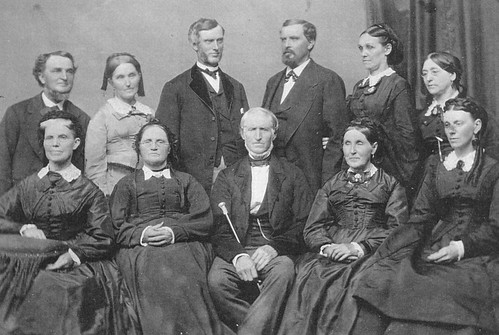
In my old files is a photograph of ancestors named Grover. I know who most of them are, too. The one in the back row a bit to the right of center with a beard was a U.S. Congressman in 1865. The folks in the picture are his brothers and sisters and a couple wives. They were all born about the turn of the century—the nineteenth century, that is.
What is remarkable about these people cannot be told from the photo. It is that they were all dirt-poor as kids. Their father was a farmer who lost a leg and who had to find another means of support for his twelve kids. He became a shoemaker in a small town in western New York State and supported everyone that way. It was through diligence and effort that he did a good job. What you see in the picture are fairly successful people in middle age, however grim they might appear. The seated man is a successful doctor while the congressman is a lawyer, politician, banker, farmer and land owner.
Dirt-poor no longer, theirs is a typical American story of personal growth in a nation that was growing.
The Grovers were religious. But people in other nations are religious. What seems to have made a difference with the Grovers and countless others is that they were optimistic, religious and free. Freedom was the catalyst, but the peculiar mixture of optimism and religion with the freedom made their lives and even ours possible. It is what separates us from the rest of the world, certainly from Europe.
There is an American culture. It has been in development for over two centuries and it is thrusting us forward toward unrivaled wealth and power. We do not want to give it up to satisfy the people who have their eyes fixed on European styles of civilization. Most of our ancestors came here to get away from European ways. They knew something some of us seem to have forgotten.
I am republishing a 1903 Grover genealogy. Included in the old details of the family will be corrections and additions and a few family stories. The Internet has allowed much more information to be discovered since 1903. My mother was one of the last to be recorded in the old book, so I can add a few more generations. It will not be a big seller, but for those of us in the Grover clan, it will be a very important book, almost as important as the family Bible.
Culture Freedom Genealogy history Conservatives
Thursday, December 15, 2005
Freedom Crosses the Centuries
Fortunate in friends, I was offered by one a copy of the book 1776 by the careful writer, David McCullough. As I read his pages, gobbling up the history of the Continental Army in America, I came across a quote from The New England Chronicle signed by a person who called himself "A Freeman." He said about America's battle for freedom, "Never was a cause more important or glorious than that which you are engaged in; not only your wives, your children, your distant posterity, but humanity at large, the world of mankind, are interested in it; for if tyranny should prevail in this great country, we may expect liberty to expire throughout the world." I added the italics.
What foresight! The writer was prophesying , correctly as it turned out, that if America lost its battle against England, the potential for freedom in the world would suffer in the distant future. Somehow this writer was able to step outside his daily experience and see across the centuries.
It is early in the morning of December 15, 2005 as I write this. Headlines flashing across the Internet (from the AP) are saying, "Iraqis voted in a historic parliamentary election Thursday, with strong turnout reported in Sunni Arab areas that had shunned balloting last January. . ."
Americans are responsible for the ability of Iraqis to vote. They are the distant posterity written about in 1776. While not necessarily blood-descendants of the Revolutionary soldiers as some of us are, today's freedom-loving Americans who cared enough to fight so that Iraq citizens might be free, are political descendants. They are the ones whose American heritage takes them to a distant country so that they might share their freedom.
Freedom is infectious. The American Heritage is important not only to Americans but to others around the world. People want to be free. Not only do most of us want to help them to be free, but it is in our self interest to make them so; democratic nations seldom war against each other.
It will be a glorious badge of honor to wear--the one that says "I helped Iraq to free itself from tyranny." Many of us see Iraqi freedom as the beginning of freedom throughout the Middle East. It is still true that "humanity at large, the world of mankind, are interested in it."
Thank you, David McCullough and thank you "A Freeman," for reminding us.
Freedom Iraq David MCCullough History American Revolution Military Conservatives Politics
What foresight! The writer was prophesying , correctly as it turned out, that if America lost its battle against England, the potential for freedom in the world would suffer in the distant future. Somehow this writer was able to step outside his daily experience and see across the centuries.
It is early in the morning of December 15, 2005 as I write this. Headlines flashing across the Internet (from the AP) are saying, "Iraqis voted in a historic parliamentary election Thursday, with strong turnout reported in Sunni Arab areas that had shunned balloting last January. . ."
Americans are responsible for the ability of Iraqis to vote. They are the distant posterity written about in 1776. While not necessarily blood-descendants of the Revolutionary soldiers as some of us are, today's freedom-loving Americans who cared enough to fight so that Iraq citizens might be free, are political descendants. They are the ones whose American heritage takes them to a distant country so that they might share their freedom.
Freedom is infectious. The American Heritage is important not only to Americans but to others around the world. People want to be free. Not only do most of us want to help them to be free, but it is in our self interest to make them so; democratic nations seldom war against each other.
It will be a glorious badge of honor to wear--the one that says "I helped Iraq to free itself from tyranny." Many of us see Iraqi freedom as the beginning of freedom throughout the Middle East. It is still true that "humanity at large, the world of mankind, are interested in it."
Thank you, David McCullough and thank you "A Freeman," for reminding us.
Freedom Iraq David MCCullough History American Revolution Military Conservatives Politics
Sunday, December 11, 2005
Pages of History
When I was a kid in the late 1930’s we had several Regular Army officers as friends of the family. They told stories about Col. George Patton and his high society following, his polo ponies, and the envy that followed him because he was so wealthy. Even the doctor the army sent over to save Patton’s life in 1945, Glenn Sperling, was a good friend of one of the members of my family. And my first cousin was Patton’s HQ Commandant. Both my cousin and his wife knew the Pattons and General Wayne and Mrs. Clark.
It was natural for me to follow the career of the famous General as I grew up. Here it is, years later, and I am still involved with his career, this time by writing a small history of WWII in which Patton took a large part.
That is why I have added two pages to my conglomeration of web sites. I have added one for General Patton and one for the Fifth Army. I am hoping that those people who are interested in reading something new about Patton and Clark and the Fifth Army will take a look at my book. It is the only new material that has been written for years.
Patton Mark W. Clark Fifth Army WWII Italian Campaign Borghese King George VI Winston Churchill Eisenhower Lucian Truscott Salerno Anzio
It was natural for me to follow the career of the famous General as I grew up. Here it is, years later, and I am still involved with his career, this time by writing a small history of WWII in which Patton took a large part.
That is why I have added two pages to my conglomeration of web sites. I have added one for General Patton and one for the Fifth Army. I am hoping that those people who are interested in reading something new about Patton and Clark and the Fifth Army will take a look at my book. It is the only new material that has been written for years.
Patton Mark W. Clark Fifth Army WWII Italian Campaign Borghese King George VI Winston Churchill Eisenhower Lucian Truscott Salerno Anzio
Wednesday, December 07, 2005
A General in the Marines
“I’ve sent a lot of men to their deaths,” my friend once told me. It has been my pleasure to know a man who has seen all kinds of trouble, and he has seen it on behalf of his beloved country. In World War II Tom enlisted as a swab jockey recruit, the lowest form of life there was in the U.S. Navy. Or anywhere else, for that matter. I know. I have been one.
A big man, half American Indian and half Irish, he stands at least six foot two. So there wasn’t any way for him to hide behind other recruits. He just stood out.
Somehow Tom and the Navy parted. He immediately enlisted in the Marines at a very low level. I know he flew pursuit planes. And that he was in the Korean War and the Vietnam War. I also know that when Tom was finally retired, he was a Lt. General in the Marines. He is not the type to run a desk. He is what some would call a combat general. I have seen him in full dress Marine uniform with lots of medals and campaign ribbons. I don’t know what they all mean, except for the Purple Heart.
Even though I am still deathly afraid of military officers, I generated enough courage to ask Tom if I could write a small book about him. I figured that anyone who went into the military as a seaman recruit, who went through three wars, and who emerged as a three star general in the Marines must have a hell of a story to tell. And I have five books to my credit already, one of them a small history of part of WWII in North Africa and Italy.
But when I asked permission to write, this giant Marine said, “What for? I didn’t do anything.”
Marines writing Patriotism Culture
A big man, half American Indian and half Irish, he stands at least six foot two. So there wasn’t any way for him to hide behind other recruits. He just stood out.
Somehow Tom and the Navy parted. He immediately enlisted in the Marines at a very low level. I know he flew pursuit planes. And that he was in the Korean War and the Vietnam War. I also know that when Tom was finally retired, he was a Lt. General in the Marines. He is not the type to run a desk. He is what some would call a combat general. I have seen him in full dress Marine uniform with lots of medals and campaign ribbons. I don’t know what they all mean, except for the Purple Heart.
Even though I am still deathly afraid of military officers, I generated enough courage to ask Tom if I could write a small book about him. I figured that anyone who went into the military as a seaman recruit, who went through three wars, and who emerged as a three star general in the Marines must have a hell of a story to tell. And I have five books to my credit already, one of them a small history of part of WWII in North Africa and Italy.
But when I asked permission to write, this giant Marine said, “What for? I didn’t do anything.”
Marines writing Patriotism Culture
Subscribe to:
Posts (Atom)